Temnodontosaurus

Megalodon

Mobil James Bond bakal Disulap Jadi Mobil Selam Sungguhan

XL Bidik 40 Persen Pelanggan Gunakan E-Channel

Idm 6.17 Full Version Download With Patch 100% working.

Tuesday, January 7, 2014

Top 15 Unusual Deep Sea Creatures

Edwardchristhoper,blogspot.com - The deep seas are often considered to be the last great, unexplored regions on Earth. Every year hundreds of hitherto unknown creatures are discovered ranging from tiny crustaceans to monster fish, and hundreds, even thousands, remain hidden awaiting our cameras. Here are 15 of the most unusual deep water denizens.
15. Ocean Sunfish
Ocean Sunfish
The ocean sunfish (Mola mola) is the heaviest bony fish in the world, with an average weight of 1000 kilograms. The species is native to tropical and temperate waters around the globe.
14. Megamouth Shark
Mega Mouth Shark
This shark is an extremely rare and unusual species of deep water shark. Discovered in 1976, only a few have ever been seen, with 39 specimens known to have been caught or sighted as of 2007 and three recordings on film. Like the basking shark and whale shark, it is a filter feeder, and swims with its enormous mouth wide open, filtering water for plankton and jellyfish.
13. Chimaera
Chimera
This strange cartilaginous fish uses its long snout to scan over the sea floor for the electrical impulses of its prey that bury in the muddy sea floor, just like a metal detector.
12. Fangtooth
Fangtooth
This fish, also called an ogrefish, while understandably named for their disproportionately large, fang-like teeth and unapproachable visage, are actually quite small and harmless to humans: the larger of the two species, the common fangtooth, reaches a maximum length of just 16 centimetres (6 inches); the shortthorn fangooth is about half this size.
11. Pelican Eel
Pelican Eel
The pelican eel’s most notable feature is its enormous mouth, much larger than its body. The mouth is loosely-hinged, and can be opened wide enough to swallow a fish much larger than itself. The pouch-like lower jaw resembles that of a pelican, hence its name.
10. Blue-Ringed Octopus
Blue-Ringed Octopus
The blue-ringed octopus is the size of a golf ball, but its venom is powerful enough to kill humans. There is no known antidote.
9. Viperfish
Viperfish
With a fearsome grin fit for a movie monster, the viperfish is a real-life predator that lurks in one of the world’s most remote locations.
8. Grenadiers
Grenadier
This large species has a rounded head and a mouth which faces forward to catch squid and fish that swim up off the sea floor. As in most other rattails, the males of this species have a special drum machine on their swim bladder that is used to attract females.
7. Vampire Squid
The Vampire Squid is covered entirely in light-producing organs called photophores. The animal has great control over the organs, capable of producing disorienting flashes of light for fractions of a second to several minutes in duration.
6. Glass Squid
Glass Squid-1
With its polka-dot mantle and wide-eyed expression, this glass creature represents a lighter side of the inky ocean deep.

5. Giant Squid
Giant Squid
The elusive giant squid, known to science as Architeuthis dux, is one of the world’s largest animals, reaching a length of up to 60 feet. It is the largest known invertebrate in the world.
4. Giant Isopod
Isopod
These creatures are thought to be abundant in cold, deep waters of the Atlantic and Pacific Ocean.
3. Football Fish
Football Fish
The species holds pride of place as the first deep-sea angler ever found. The original specimen washed ashore in Greenland in 1833; at 22 inches long, it is still the largest one on record. Since no females of this species have ever been found bearing parasitic males, biologists assume they are fertilized by free-swimming mates.
2. Pacific Blackdragon
Blackdragon
Female blackdragons are about two feet (61 cm) long and have fanglike teeth and a long chin whisker. The males are small, about three inches (8 cm) in length, and brownish in color. They have no teeth, no chin barbel and no stomach. Unable to eat, the male lives only long enough to mate.
1. Amphipod
Amphripod

The unusual animal, called Phronima, an Amphipod, is one of the many strange species recently found on an expedition to a deep-sea mountain range in the North Atlantic.

Source : http://listverse.com

Kronosaurus queenslandicus

Edwardchristhoper.blogspot.com - Kronosaurus queenslandicus, from the Early Cretaceous of Queensland, was the largest known pliosaurid. These huge marine carnivores plied the oceans and inland seas during the Mesozoic, using both pairs of limbs to 'fly' underwater. Kronosaurus would have hunted large fish, invertebrates such as giant squid and ammonites, and perhaps even other large reptiles like elasmosaurids and ichthyosaurs.
Pliosaur, Kronosaurus queenslandicus
© Australian Museum

Identification

Plesiosaurs (pliosaurids and elasmosaurids) were secondarily marine tetrapods that evolved from a group of terrestrial sauropterygian reptiles during the latest Triassic. The limbs of plesiosaurs were developed into paddles, and the limb girdles formed large ventral plates akin to the plastron of turtles. Pliosaurids were short-necked with proportionately large heads, while elasmosaurids generally had small heads and long necks (the 'pliosaurid' body plan apparently evolved independently in at least three plesiosaur lineages). The skulls of pliosaurids were massive, leading to overestimates of their total lengths.
Kronosaurus was the largest of the pliosaurids. Its skull was at least 2.4m long (proportionately large for the estimated body length of no more than ten meters). References to a length for Kronosaurus of nearly 13 meters are exaggerated. The teeth of Kronosaurus are conical, crushing teeth like those of pliosaurids that fed on the plentiful, hard-shelled ammonites of Cretaceous seas.
Kronosaurus queenslandicus was most closely related to the only other known species of Kronosaurus, K. boyacensis from the Early Cretaceous of the Boyaca region, northern Colombia.

Size range

8 m - 10m long (head-tail)

Distribution

Kronosaurus queenslandicus was found at Army Downs near Hughenden in north-central Queensland. Isolated teeth referable to Kronosaurus are reported from the Walumbilla Formation, White Cliffs, New South Wales and from the Bulldog Shale, northern South Australia.

Habitat

Kronosaurus lived in the cool, high-latitude Eromanga Sea - an inland sea that covered vast areas of inland Australia from 120-90 million years ago (Aptian-Albian-Cenomanian). Glendonites and boulders that may have been rafted by ice are evidence of cold to near-freezing conditions during the austral winter.

Life cycle

Plesiosaurs propelled themselves through the water using lift-based appendicular locomotion, as in birds, sea lions and sea turtles. However, only plesiosaurs used both forelimbs and hindlimbs in locomotion. Pliosaurids (unlike elasmosaurids) were able to cruise at high speeds for long periods of time.

Fossils

Kronosaurus queenslandicus was named in 1901 from a jaw fragment with six teeth found near Hughenden, north-central Queensland. This material was originally described as ichthyosaur by Longman (1921) who later revised this as pliosaur (1924). The most well known fossils of Kronosaurus are those of an individual (a skull and most of the skeleton) found at 'Army Downs' near Hughenden in central Queensland by an expedition from Harvard University (1930 -- 1931). This skeleton was taken back to Harvard, where it is still held by the Museum of Comparative Zoology (MCZ). A reconstruction of Kronosaurus incorporating the fossil material is displayed at the MCZ. There has been no complete description or comparisons with the type material in Australia (the type specimen is held by the Queensland Museum in Brisbane). It is therefore possible that the material held by the MCZ will need to be revised.
The skeleton on display at the MCZ (nicknamed 'Plasterosaurus') is one-third plaster, and liberties have been taken in reconstructing its size. The reconstructed skeleton, although impressive, is 12.8 metres long, about three metres too long. The modeled skeleton took almost thirty years to produce, the original bones having been discovered in 1931.

Era / Period

Cretaceous Period

Source : http://australianmuseum.net.au   

Sunday, January 5, 2014

ONCHOPRISTIS NUMIDUS


ONCHOPRISTIS NUMIDUS ( SAWFISH ) ROSTRAL TOOTH
Tegana Formation - Kem Kem, Morocco
UPPER CRETACEOUS PERIOD:  97.5 - 91 million years ago
Edwardchristhoper.blogspot.com - These are one of the most fascinating fossil teeth available from a very bizarre creature that is not widely known, Onchopristis numidusOnchopristis numidus is an extinct large sawfish that lived during the days of the dinosaurs.  This particular Onchopristis numidus rostral tooth specimen is intact with NO REPAIR and NO RESTORATION.  Intact teeth of fine quality are very rare because these teeth are dug and often found in hard sediments.  They are almost always damaged during the extraction process.  Choice enamel, color and preservation.
Related to the modern day sawfish, the Onchopristis had a long, hard shovel-shaped snout lined on both sides with barbed teeth.  This fascinating member of the shark and ray family trolled the murky bottoms of warm Cretaceous seas nearly 100 million years ago.  To gain insight as to how this extinct animal might have lived we can examine the modern day sawfish.
Sawfishes are very lethargic animals, spending much of their day nestled in the muddy sea/river floor. At night, they scull slowly through the shallows, using their sensitive saw to find buried prey, which are then raked from the sediment to be consumed. It is useful to view the sawfishes' unique rostrum like a metal detector combined with a clam rake.

If small fishes, like mullet, swim past a hungry sawfish, this great ray will launch from the bottom, slashing its toothy weapon rapidly side to side. Gouged by the snout's awl-shaped teeth, injured fishes tumble to the sea floor, now immobilized and easy to catch!

Apart from its use in finding and disabling prey, the toothy rostrum is also a weapon of defense. When threatened, sawfishes will smack this jagged sword against attackers, whether they be sharks or fishermen. Generally, though, sawfishes are very gentle animals, preferring to lie quietly, undisturbed.

Very little is known about sawfish life history, but the late Dr. Thomas Thorson performed studies on a freshwater species, the Largetooth sawfish ( Pristis perotteti) from Lake Nicaragua. According to his findings, this sawfish lives approximately 25-30 years, attaining maturity in about 10 years. Females give live birth and pup sawfishes are around 2.5 ft long at birth, reaching a maximum length of 23 ft! A rubbery envelope surrounds the softened saw at birth to protect the mother from harm. It is thought that mating occurs every other year, with an average litter size of approximately 8 pups.

Sawfishes love muddy shallow water, and this is why many people are unaware of them. Few humans, apart from tribal villagers and fishermen venture into sawfish domain. These elasmobranchs possess a remarkable physiological system allowing them to travel from the sea into freshwater at will. Some species seem to spend most of their lives in rivers and lakes! It is likely that sawfishes require a variety of habitats and salinities to complete their lifecycle.
Roughly 40 species of modern sawfishes are known; only a handful survive today.
NICE ROBUST EXAMPLE!
1.5" long on the diagonal leading edge
SOLD     MV17-001     INCLUDES DISPLAY BOX     Actual Item - One Only 


Source : http://www.paleodirect.com

Cretoxyrhina Mantelli

Image: A Cretoxyrhina


Edwardchristhoper.blogspot.com - Cretoxyrhina was one of the largest sharks and a formidable predator in the Late Cretaceous seas. Nicknamed the Ginsu shark after the kitchen knife that slices and dices, Cretoxyrhina ripped apart prey with a mouth full of razor-sharp, bone-shearing teeth. Evidence suggests Cretoxyrhina fed on mosasaurs, plesiosaurs, and even the giant bony fish Xiphactinus, a fierce predator itself.
Sharks are made of cartilage, which does not fossilize well. Much of what is known about them comes from their abundant—and harder—teeth. Cretoxyrhina's were smooth, curved, and grew more than two inches (five centimeters) long. Bite marks and teeth embedded in the bones of its prey suggest Cretoxyrhina chomped with brutal force.
Estimates from a few calcified remains of cartilaginous Ginsu sharks suggest they grew upwards of 24 feet (7 meters) long, similar in size to modern great white sharks. Though fierce and feared, Cretoxyrhina was preyed upon by the giant mosasaur Tylosaurus, and Ginsu remains were scavenged by the smaller shark of its time, Squalicorax.

Fast Facts

Type:
Prehistoric
Diet:
Carnivore
Size:
Up to 24 ft (7 m)
Protection status:
Extinct
Did you know?
Fossil tooth marks suggest Cretoxyrhina and Squalicorax sharks went after the same food, either hunting together or stealing from each other.
Size relative to a bus:
Illustration: Cretoxyrhina mantelli compared with bus

Source : http://animals.nationalgeographic.com

The First Shark - Cladoselache

    cladoselache

Cladoselache (Nobu Tamura)

Edwardchristhoper.blogspot.com - The difficult-to-pronounce Cladoselache (its name means "branch-toothed shark") lived during the late Devonian period, about 370 million years ago, making it the earliest shark in the fossil record. If you'll forgive us for mixing our genera, Cladoselache was certainly an odd duck: it was almost completely devoid of scales, except for specific parts of its body, and it also lacked the "claspers" modern sharks use to mate with the opposite sex. Clearly Cladoselache figured this tricky business out, since it eventually went on to spawn Megalodon and the Great White Shark hundreds of millions of years later.

Source : http://dinosaurs.about.com

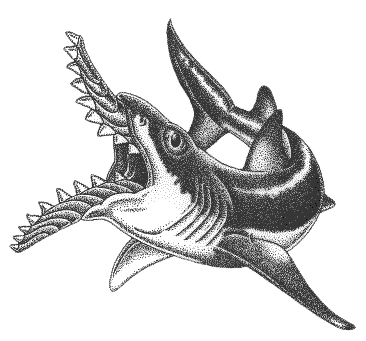
Edestus.

Edwardchristhoper.blogspot.com - Edestus is a mysterious genus of edestid shark. Some of the other edestids are Sarcoprion, Ornithoprion, Parahelicoprion, Helicoprion, and Campyloprion. There are five species of edestus: E. giganteus, E. heinrichi, E. mirus, E. minor, and E. vorax. Edestus giganteus is the most mysterious species of edestus, because people have only found one fossilized row of teeth.


This fossil of Edestus shows what the pinking-shear-like saw looked like. No one really knows where in the jaw the pinking shears went---if one went out of the lower jaw, if one went out of the upper jaw, or if there was one on the lower jaw and one on the upper jaw. Edestus may have used its saw to cut prey in half.


The jaw isn't the only mysterious part of Edestus, because no one knows what Edestus's body looked like---if it was long, tapering and eel-like, like the body of a Xenacanth shark, or if it was more shark-like, like the body of a modern day shark.


Source : http://www.lifebeforethedinosaurs.com

Scapanorhynchus


Name: Scapanorhynchus (Spade snout).
Phonetic: Skap-an-o-rink-us.
Named By: Woodwood - 1889.
Classification: Chordata, Chondrichthyes, Elasmobranchii, Selachimorpha, Mitsukurinidae.
Species: S. praeraphiodon, S. rapax, S. raphiodon, S. texanus.
Diet: Carnivore/Piscivore.
Size: Specimens indicate a length of approximately 65 centimetres, but some larger fossil teeth hint at a much larger size of up to 3 meters long.
Known locations: Worldwide.
Time period: Aptian through to the Maastrichtian of the Cretaceous. May have survived into the early Paleogene.
Fossil representation: Usually just the teeth, some complete body impressions are also known.
       Scapanorhynchus appears to have been so much like the living goblin shark (Mitsukurina owstoni) that the two were considered by some to be the same genus. However study of the teeth has brought the conclusion that while very similar, they are different enough to keep the two separated.
       The most striking feature of Scapanorhynchus is the extended snout that projects forward well ahead of the jaws. This snout was probably filled with electro-receptive ampullae that sensed the movements of nearby fish. This indicates that like the goblin shark, Scapanorhynchus was a deep water species that hunted in the darkness where sunlight could not penetrate. Here vision would be useless, but he electric sensors of its snout would easily find prey as it swam about, possibly unaware of the presence of Scapanorhynchus.
       Aside from generally being considered to be smaller than the goblin shark, Scapanorhynchus has quite different fins. The main difference here is the proportionately larger tail fin the superior (upper) lobe of which was huge in comparison to the bottom lobe. Not only does this indicate that Scapanorhynchus was not a strong open water swimmer, it also suggests that it probably just lurked in the darkness waiting for prey, perhaps near the bottom.
       Although usually considered to be small, the teeth of S. texanus have been measured at around five centimetres. This makes them a similar size to the teeth of the goblin shark which has been recorded at almost three and a half meters in length. However because of this large size and the fact that the teeth have been recovered from what appears to have been a relatively shallow water environment, some researchers have questioned its inclusion within the Scapanorhynchus genus.

Source : http://www.prehistoric-wildlife.com

Wednesday, January 1, 2014

Huge Flying Reptiles Ate Dinosaurs


Sistem Jaringan Komputer BBC Dibobol Peretas Rusia

Thumbnail
REUTERS/Toby Melvill
Selasa, 31 Desember 2013 WIB

Edwardchristhoper.blogspot.com - Jakarta: Seorang peretas dari Rusia mengendalikan sistem jaringan komputer BBC dan berusaha menjual akses ke server itu ke penjahat cyber lain, demikian kata sejumlah laporan.

Perusahaan AS Hold Security mengatakan kepada Reuters dan Financial Times bahwa mereka mengetahui bahwa si peretas mengiklankan hasil kerjanya di sebuah forum pasar gelap pekan lalu.

Belum diketahui apakah si peretas berhasil menjual aksesnya sebelum BBC mengambil tindakan responsif.

Seorang juru bicara BBC mengatakan bahwa pihaknya memilih untuk tidak mengomentari isu-isu keamanan.

Sistem jaringan komputer itu diduga disusupi melalui situs berbagi dokumen ftp.bbc.co.uk. (bbc.co.uk)

Editor: Retno Hemawati    

Sumber : http://www.metrotvnews.com                                                                                     

Dell Manfaatkan Jerami untuk Produk Terbaru

Thumbnail
REUTERS/Mario Anzuoni
Jumat, 20 Desember 2013 WIB

Edwardchristhoper.blogspot.com - Surabaya: Perusahaan komputer Dell Inc memanfaatkan jerami dari sisa panen tanaman gandum sebagai salah satu bahan baku untuk mengemas produk komputer jinjing atau laptop terbaru yang dipasarkan akhir 2013 ini.

Country Manager & Director Consumer Dell Indonesia, Primawan Badri kepada wartawan di Surabaya, Jumat (20/12), mengemukakan pemanfaatan jerami merupakan bentuk komitmen perusahaan untuk ikut menjaga kelestarian alam dan membantu konsumen mengurangi jejak karbon. "Produk terbaru Dell Inspiron seri 7000 merupakan laptop pertama yang sebagian kemasannya menggunakan jerami, yaitu sisa tanaman gandum setelah panen yang biasanya dibakar oleh petani," katanya saat peluncuran sejumlah seri terbaru produk laptop.

Menurut Primawan, pemanfaatan jerami juga akan membantu industri terkait untuk berkembang, sembari mempertahankan komitmen perusahaan terhadap kelangsungan lingkungan hidup.

Selain Inspiron 7000, Dell Indonesia juga merilis dua produk terbaru lainnya untuk bersaing di pasar dalam negeri yang semakin ketat, yaitu Inspiron 11 Seri 3000 dan Vostro 5470 yang tipis dan super ringan. "Konsumen di Indonesia menginginkan produk yang tidak hanya handal dan mudah digunakan, tapi juga memiliki semua fitur dalam satu desain yang tipis dan mewah. Tiga produk tersebut untuk menyasar segmen pelajar dan mahasiswa, serta profesional," tambahnya.

Ia mengakui pasar laptop di Indonesia masih cukup menjanjikan, kendati beberapa tahun terakhir sedikit terpengaruh dengan kehadiran komputer tablet yang banyak dilirik konsumen. "Sampai saat ini, Dell belum tertarik untuk ikut bersaing di pasar tablet meskipun potensinya menjanjikan. Kami melihat potensi pasar laptop di Indonesia masih cukup besar," ujar Primawan.

Sebelumnya, lembaga analis data, IDC merilis hasil riset yang menyebutkan total penjualan "notebook" di Indonesia pada kuartal kedua tahun 2013 mencapai 913.652 unit. Jumlah tersebut sedikit mengalami penurunan dibandingkan dengan kuartal pertama 2013 yang mencapai 976.513 unit. (Ant)

Editor: Retno Hemawati

Sumber :http://www.metrotvnews.com                                                                                            

Lenovo Berencana Salip Samsung dan Apple

Thumbnail
Reuters/Bobby Yip/vg
Selasa, 31 Desember 2013 WIB , Laporan: Desi Angriani

Edwardchristhoper.blogspot.com - New York: Lenovo tak berpuas diri menjadi produsen pintar terbesar kedua di negara asalnya, China. Pasalnya, ia berambisi menyalip Samsung dan Apple setelah sebelumnya berhasil menyalip HP sebagai produsen komputer pribadi terbesar di dunia.

"Aspirasi kami adalah suatu hari nanti menjadi nomor 1 di ruang mobile. Aku tahu ini kedengarannya gila, tapi bahkan lima tahun yang lalu, jika saya mengatakan kami akan menjadi produsen komputer pribadi nomor 1, orang akan mengatakan kami gila." kata Wakil Presiden Lenovo JD Howard.

Seperti yang ditulis dalam NewYork Times, Lenovo punya tantangan besar jika ingin berkuasa di pasar negara maju. Sebagaimana yang diketahui pasar ponsel tengah dikuasai Apple dan Samsung.

Berdasarkan pengakuannya, mulai 2014 nanti Lenovo akan agresif di pasar Amerika Serikat dan Eropa. Untuk itu, Lenovo harus segera memperluas fokus bisnisnya ke perangkat mobile, mengingat kecenderungan bahwa bisnis komputer pribadi terus menurun. "Lenovo merasakan tekanan, tapi mungkin mereka lebih siap menghadapi cuaca badai," kata analis dari ABI Research Jeff Orr.

Hal senada juga disampaikan analis dari Gartner, Mikako Kitagawa yang menilai bahwa Lenovo butuh waktu untuk meraih sukses di negara maju.

"Aku hanya tidak bisa membayangkan Lenovo datang ke pasar ponsel pintar AS dan membangun pangsa pasar dengan cepat," ungkap Kitagawa.

Walaupun Lenovo punya ponsel andalan seperti Vibe Z alias K910 yang dibekali prosesor kelas atas Qualcomm, Snapdragon 800. Namun pesaing lainnya yang patut diwaspadai Lenovo di antaranya Huawei, ZTE, Oppo, dan Xiaomi, yang turut mengepakkan sayap di negara berkembang. Termasuk Indonesia yang menjadi salah satu pasar potensial yang tengah diincar negara Tirai Bambu itu.

Tahun 2005 silam, Lenovo mengakuisisi unit bisnis komputer pribadi International Business Machines (IBM) yang terkenal melalui merek dagang ThinkPad. Lenovo sukses meningkatkan bisnis komputer pribadi dan komputer jinjing, serta makin agresif di pasar negara maju, seperti Jerman dan Jepang.(NewYork Times)

Editor: Rizky

Sumber : http://www.metrotvnews.com                                                                                           

Operator Telekomunikasi Antisipasi Lonjakan Trafik Jelang Tahun Baru

Thumbnail
ANTARA/ip
Selasa, 31 Desember 2013 WIB

Edwardchristhoper.blogspot.com - Jakarta: Kementerian Kominfo kembali mengingatkan kepada para penyelenggara telekomunikasi untuk untuk benar-benar minimal menjaga kualitas layanan telekomunikasinya mengingat diperkirakan terjadi lonjakan trafik telekomunikasi.

Hal ini terkait dengan imbauan Badan Regulasi Telekomunikasi Indonesia (BRTI) kepada para penyelenggara telekomunikasi terkait persiapan perayaan Natal 2013 dan Tahun Baru 2014 yang disampaikan melalui Siaran Pers Kementerian Kominfo pada tanggal 2 Desember 2013.

Khusus untuk pergantian tahun baru yang hanya tinggal beberapa jam lagi, Kementerian Kominfo telah melakukan pengecekan kesiapan ke sejumlah penyelenggara telekomunikasi terkait dengan daya dukung para penyelenggara telekomunikasi di sejumlah sentra keramaian pesta tahun baru, seperti misalnya sekitar Thamrin dan Bunderan HI, Ancol dan TMII Jakarta.

Secara umum mereka menyampaikan informasi kesiapannya, baik dengan ada yang menempatkan Mobile BTS, penambahan kapasitas jaringan maupun berkoordinasi langsung dengan Pemda DKI. Pengecekan ini penting karena diperkirakan akan banyak ribuan warga masyarakat yang saling berkomunikasi dan mengabadikan moment-moment penting dengan perangkat telekomunikasi yang terakses internet, sehingga dapat meng- up load -informasi, foto dan videonya secara langsung di media sosialnya.

Imbauan ini tidak hanya ditujukan untuk mem-back up kesiapan pesta tahun baru di Jakarta, tetapi juga di seluruh Indonesia, khususnya di lokasi-lokasi dimana berlangsung pesta keramaian berlangsung. Dan bahkan mengingat aktivitas Gunung Sinabung di Sumatera Utara masih cukup mengkhawatirkan, maka seluruh komunitas mitra Kementerian Kominfo (baik para penyelenggara telekomunikasi maupun RAPI dan ORARI) tetap menunjukkan kesiagaannya agar komunikasi di daerah bencana sekitar Gunung Sinabung masih aman dan terkendali. (RO)

Editor: Retno Hemawati

Sumber :  http://www.metrotvnews.com                                                                                          

Monsters in Greek Mythology

Some of the scariest creatures ever devised in the mind of man were introduced through Greek mythology. They were one-eyed and many-eyed giants, a three-headed dog, a terrifying woman with real-snake locks of hair, man-eating beasts with half-human bodies, giant-winged creatures with heads of beautiful maidens and many-headed grotesque sea monsters. They horrified and intrigued us, mesmerizing the deepest cubby-holes of our vivid imaginations.

CYCLOPES
Cyclops
Gigantic one-eyed monsters that represented thunder, lightning and the lightning bolt. They were giants with a single eye in the middle of their forehead and four dispositions. The Cyclopes gave Zeus his weapons of thunder and lightning, which aided greatly in the defeat of the ten-year war against the Titans. The wandering hero, Odysseus, blinded the Cyclops Polyphemus, who happened to be a son of Poseidon. They were the first smiths, and created Poseidon’s trident, Artemis’ bow and arrows of moonlight, Apollo’s bow and arrows of sun rays, and Hades’ helmet of darkness. Noises proceeding from the heart of volcanoes were attributed to their forge operations.

MEDUSA
Medusa
A former mortal maiden of great beauty who was transformed into an ugly monster with snake-like hair by Athena after Poseidon raped her on her temple floor. She was so hideous that anyone who looked upon her was turned to stone. Perseus eventually beheaded Medusa, and her head was placed on the shield of Athena. It is said that Medusa’s blood that dripped from her wounds after her decapitation caused the innumerable serpents that infest Africa today.

MINOTAUR

The minotaur was a fearful man-eating beast who was half-man and half-bull. To prevent the minotaur from eating his own people, Minos had the beast shut up in a complex maze. Each year, Minos ordered the Athenians to send over seven young men and seven young women to be fed to the minotaur. Theseus volunteered to replace one of the young men who was to be sacrificed to the monster, and successfully solved the maze and slayed the minotaur.

SIRENS
Sirens
The Sirens were sisters-giant, winged creatures with the heads of beautiful women-who lured sailors to the deaths. Their songs were irresistible and lured boats towards treacherous rocks that would cause their demise. Odysseus filled his sailors’ ears with wax so that they could sail safely past the enchanting music of the Sirens.

ARGUS

450 × 410 - theoi.com
A giant with one hundred eyes (the “all-seeing one”), Argus’ most infamous role was that as guardian over IO, the heifer-nympth loved by Zeus. Zeus’ jealous and vengeful wife, Hera, employed him to watch over her night and day with his many eyes. Finally, he was killed by Hermes, and Hera put Argus’ eyes in the tail of the peacock, her favorite bird.

CERBERUS


The huge and powerful three-headed dog with a snake tail owned by Hades, Lord of the underworld. Snakes heads also protruded from his back. He used this fearsome hound to guard the entrance to his dark realm, allowing the dead to enter, but never to leave. Fetching Cerberus from the underworld and presenting him to King Eurystheus was the last labor of Heracles.

SCYLLA
Scylla, the sea-monster | Paestan red figure krater C4th B.C. | J. Paul Getty Museum, Malibu
Scylla was a horribly grotesque sea monster, with six long necks equipped with grisly dog-heads, each of which contained three rows of sharp teeth. Her body consisted of twelve canine legs and a cat’s tail. She ate sailors alive, including some of Odysseus’ men.

CHARYBDIS


Charybdis took form as a monstrous mouth who swallowed huge amounts of water three times a day and then belched back out creating whirlpools, which caused destruction to many ships and the deaths of many sailors. She was originally a sea-nymph who was turned into a sea monster by Zeus as punishment for stealing Heracles’ cattle.

Source :http://www.lifepaths360.com

Top 10 Terrifying Prehistoric Sea Monsters

Edwardchristhoper.blogspot.com - The modern ocean is a scary place, filled with barracuda, sharks, super-squids, and possibly Cthulhu. However, no matter what we find in the depths these days, none of them seem to come close to the giant terrors that roamed the seas in Earth’s past; giant sea-lizards, monster sharks and even “hypercarnivorous” whales. For most of these things, humans would barely qualify as a snack.
Here are 10 of the scariest prehistoric sea monsters to ever call the ocean home in prehistory.

10. Megalodon

Megalodon
Megalodon is probably the best-known creature in the list; it’s hard to keep the idea of a shark the size of a school bus out of pop culture. Plus, science-minded entertainment sources like the Discovery Channel love creatures that could pass for a movie monster. Despite the popular idea that Megalodon coexisted with dinosaurs, they lived from 25 to 1.5 million years ago, meaning that at best they missed the last dinosaur by 40 million years. On the other hand, this meant they might have still been around for the first humans. Eek.
Megalodons swam the warm oceans that were around until the last ice age in the early Pleistocene, which may have robbed them of their breeding grounds and food. Sometimes, it seems nature has our back.

9. Liopleurodon

Liopleurodon
If Jurassic Park had an aquarium scene, and actually featured more animals from the Jurassic period, liopleurodon probably would have been in it. Although the actual length of these beasts is contested (some scientists have claimed lengths in excess of 50’), most agree that it was around 20 feet in length, with a full fifth of that being pointy-toothed head. When the mouth of the “smaller” estimate is still plenty large to eat you whole, I think that is perfectly huge enough.
Scientists have tested the paddle design of these creatures on small swimming robots and found that although they would not have been incredibly fast, they were incredibly agile. They also would have been able to make short, fast burst attacks like crocodiles, which in no way makes them any less intimidating.

8. Basilosaurus

Basilosaurus
Despite the name and appearance, that is not a reptile, but actually a whale (and not even the most fearsome on the list!) Basilosaurs were predatory ancestors of modern whales, and could be 50 to 85 feet long! It is described as being the closest a whale has ever come to being a snake because of how long and sinuous it was. Imagine swimming in the ocean with an 80+ foot long alligator-snake-whale. Now imagine being afraid to even take a bath ever again.
Physical evidence suggests that basilosaurus did not have the cognitive ability of modern whales, nor the ability to echolocate, and could only navigate in 2 dimensions (so no deep diving or breaching). So at least this monster whale was dumber than a bag of prehistoric hammers and could not chase you if you dove or scrambled out on dry land, probably forever.

7. Jaekelopterus rhenaniae

Jaekelopterus rhenaniae
Nothing about the words “sea scorpion” are comforting to begin with, so this should not come off as too awful: this was one of the two largest arthropods to have ever lived, reaching a length of over 8 feet of armored, clawed horror. Most of us freak out at the thought of inch-long ants and foot wide spiders, so it’s easy to imagine screaming like a little girl if you ever stumbled across a living one of these.
On the plus side, sea scorpions (Euripterids) have been extinct since before the dinosaurs, having been wiped out in the Permian Triassic extinction event (which killed 90% of all life on earth) and are only survived, to some degree, by horseshoe crabs, which are even less formidable than regular crabs. There is no evidence that any sea scorpions were actually venomous, but the structure of their tail is similar to a modern scorpion’s, so it might have been.

6. Mauisaurus

Mauisaurus
Mauisaurus was named after the Maori god Maui, who pulled the islands of New Zealand up from the sea floor with a fish hook, so already you know this thing is going to be enormous. The neck of Mauisaurus measured up to 49 feet long; the longest proportionate (and really, “actual”) neck of any living thing aside from some sauropod dinosaurs. Their overall length was about 66 feet, and that ridiculously long neck had plenty of vertebrae, implying that it was flexible. Imagine a snake strung through a sea turtle with no shell, and you have an approximate idea of what this thing looked like.
It lived back in the Cretaceous era, meaning that creatures that jumped in the water avoid Velociraptors and Tyrannosaurs had to contend with these; the jury is out on which is worse. As far as science can tell, Mauisaurus was limited to the New Zealand area, showing that the area that would one day become Australia and its neighbors was always a land of terror.
ADVERTISEMENT

5. Dunkleosteus

Dunkleosteus
Dunkleosteus was a 30 foot long carnivorous tank. It was outlasted by sharks, but I am sure that is small consolation for the variety of creatures this beast ate. Instead of teeth, it had bony ridges, like a turtle. It has been calculated that they had a bite force of 8,000 pounds per square inch, putting it on par with crocodiles and T-Rex in terms of being history’s strongest biters. They also believe, based on the evidence in the skull regarding its musculature, that it could have opened its mouth in one fiftieth of a second, meaning it vacuumed food into its guillotine of a mouth.
The plates that made up the “teeth” changed as the fish aged from a solid, rigid jaw to segments that allowed it to hold prey easier, and made it more effective in biting through the bony plate armor of other armored fish. In the arms race that was the prehistoric ocean, Dunleosteus was a predatory super tank.

4. Kronosaurus

Kronosaurus
Kronosaurus is another short-necked pliosaur (like Liopleurodon up at number 9), and like Liopleurodon, its overall length has been contested. It was a “mere” 30 feet long and the longest teeth in its massive mouth were up to 11 inches long. This is why it was named after Cronus, the king of the old Greek Titans.
Guess where it lived? If you guessed “Australia”, then you  have been paying attention to life (and are correct). The head was up to 9 feet long. They could eat an entire modern man whole, and still have room left over for half of another. It has also been suggested that since their flippers are so similar in design to those of modern sea turtles, that they may have crawled out onto land to lay eggs. You can be sure no one was digging up these thing’s nests to get at the eggs.

3. Helicoprion

Helicoprion
These sharks grew to be about 15 feet long, and had a lower jaw that was made of a “tooth whorl”. It looks like a cross between a circular saw and a shark, and when you mix apex predators with power tools, the world quakes in fear.
Helicoprion’s teeth were serrated, implying that they were definitely carnivores, but there is some debate as to whether their teeth were in the front of the mouth, as shown in the picture, or if they were farther back, which would suggest a softer diet, like jellyfish. However it was arranged, it clearly worked; Helicoprion survived the Permian Triassic extinction, which means they may have been smart enough to create bomb shelters. Or maybe they just lived in the deep sea.

2. Livyatan melvillei

Livyatan melvillei
Remember me mentioning “hypercarnivorous” whales? Well here it is. Imagine a cross between an orca and a sperm whale. Livyatan melvillei was a whale that ate other whales. It had the largest teeth of any animal to ever use their teeth to eat (elephant tusks are bigger, but they just look impressive and help them smash things; they don’t eat with them) topping out at 1.18 feet. They lived in the same oceans and ate the same food as the Megalodon, so this whale actually had to compete with the largest predatory shark ever.
Not to mention their head was 10 feet long and featured the same echo-locating equipment as modern toothed whales, making them much more effective in murky water. In case it was not obvious, this beast was named after the leviathan, a giant sea monster from the bible, and Herman Melville, who wrote Moby Dick. If the great white whale had been one of these, it would have eaten the Pequot and everyone aboard as a snack.

1. Giant Stingray

Giant Stingray
What grew 17 feet across, had a 10 inch poison spike in its tail and was strong enough to drag a boat filled with people? In this case, a prehistoric super-fish that is still lurking around in fresh and brackish waters from the Mekong river to northern Australia. Stingrays have been around since a few million years after the dinosaurs died out, and have proven to be a successful design, much like the sharks they descended from.
The giant stingrays use that tried and true ancient design, but have somehow managed to survive ice ages and even the catastrophic Toba event. They were featured on Animal Planet’s River Monsters, and despite the host’s tendency to exaggerate damn near everything, they are incredibly dangerous to fool around with, even if you don’t know you are fooling around with one. They are notorious for putting their neurotoxin covered spike completely through limbs. I guess, on the plus side, if there is one, at least they won’t try to eat you.
David Dietle

Our friends at list25.com have posted a similar list of sea creatures.

Source :http://www.toptenz.net

Falcatus.

Edwardchristhoper.blogspot.com - Falcatus was a one-foot-long stethacanthid shark which ate shrimp.

Falcatus had a hook-shaped crest which only the males had. The crest could have been for attracting a female. But like all stethacanthids, the use for the crest is unknown. Stethacanthid means "spiny crest."

Falactus lived during the Carboniferous Period and probably had to avoid Edestus and Helicoprion.

Falcatus was the most abundant shark in the Bear Gulch Beds in Montana, and individuals have been found everywhere there. But sometimes whole schools of Falcatus have been preserved.


Falcatus isn't the only animal with the word "falcatus" in its name. There's also Parexus falcatus.  The binomial name of Falcatus is Falcatus falcatus.


The female Falcatus looked more like Cladoselache than Falcatus. The difference between the male Falcatus and the female Falcatus is that the female did not have the crest or the triangle patch of barbs on the head. The male also had a longer snout than the female.

Falcatus was probably a visual predator because of its huge eyes, which were almost the size of its head.


Source : http://www.lifebeforethedinosaurs.com