Temnodontosaurus

Megalodon

Mobil James Bond bakal Disulap Jadi Mobil Selam Sungguhan

XL Bidik 40 Persen Pelanggan Gunakan E-Channel

Idm 6.17 Full Version Download With Patch 100% working.

Showing posts with label Dinosours. Show all posts

Tuesday, January 7, 2014

Kronosaurus queenslandicus

Edwardchristhoper.blogspot.com - Kronosaurus queenslandicus, from the Early Cretaceous of Queensland, was the largest known pliosaurid. These huge marine carnivores plied the oceans and inland seas during the Mesozoic, using both pairs of limbs to 'fly' underwater. Kronosaurus would have hunted large fish, invertebrates such as giant squid and ammonites, and perhaps even other large reptiles like elasmosaurids and ichthyosaurs.
Pliosaur, Kronosaurus queenslandicus
© Australian Museum

Identification

Plesiosaurs (pliosaurids and elasmosaurids) were secondarily marine tetrapods that evolved from a group of terrestrial sauropterygian reptiles during the latest Triassic. The limbs of plesiosaurs were developed into paddles, and the limb girdles formed large ventral plates akin to the plastron of turtles. Pliosaurids were short-necked with proportionately large heads, while elasmosaurids generally had small heads and long necks (the 'pliosaurid' body plan apparently evolved independently in at least three plesiosaur lineages). The skulls of pliosaurids were massive, leading to overestimates of their total lengths.
Kronosaurus was the largest of the pliosaurids. Its skull was at least 2.4m long (proportionately large for the estimated body length of no more than ten meters). References to a length for Kronosaurus of nearly 13 meters are exaggerated. The teeth of Kronosaurus are conical, crushing teeth like those of pliosaurids that fed on the plentiful, hard-shelled ammonites of Cretaceous seas.
Kronosaurus queenslandicus was most closely related to the only other known species of Kronosaurus, K. boyacensis from the Early Cretaceous of the Boyaca region, northern Colombia.

Size range

8 m - 10m long (head-tail)

Distribution

Kronosaurus queenslandicus was found at Army Downs near Hughenden in north-central Queensland. Isolated teeth referable to Kronosaurus are reported from the Walumbilla Formation, White Cliffs, New South Wales and from the Bulldog Shale, northern South Australia.

Habitat

Kronosaurus lived in the cool, high-latitude Eromanga Sea - an inland sea that covered vast areas of inland Australia from 120-90 million years ago (Aptian-Albian-Cenomanian). Glendonites and boulders that may have been rafted by ice are evidence of cold to near-freezing conditions during the austral winter.

Life cycle

Plesiosaurs propelled themselves through the water using lift-based appendicular locomotion, as in birds, sea lions and sea turtles. However, only plesiosaurs used both forelimbs and hindlimbs in locomotion. Pliosaurids (unlike elasmosaurids) were able to cruise at high speeds for long periods of time.

Fossils

Kronosaurus queenslandicus was named in 1901 from a jaw fragment with six teeth found near Hughenden, north-central Queensland. This material was originally described as ichthyosaur by Longman (1921) who later revised this as pliosaur (1924). The most well known fossils of Kronosaurus are those of an individual (a skull and most of the skeleton) found at 'Army Downs' near Hughenden in central Queensland by an expedition from Harvard University (1930 -- 1931). This skeleton was taken back to Harvard, where it is still held by the Museum of Comparative Zoology (MCZ). A reconstruction of Kronosaurus incorporating the fossil material is displayed at the MCZ. There has been no complete description or comparisons with the type material in Australia (the type specimen is held by the Queensland Museum in Brisbane). It is therefore possible that the material held by the MCZ will need to be revised.
The skeleton on display at the MCZ (nicknamed 'Plasterosaurus') is one-third plaster, and liberties have been taken in reconstructing its size. The reconstructed skeleton, although impressive, is 12.8 metres long, about three metres too long. The modeled skeleton took almost thirty years to produce, the original bones having been discovered in 1931.

Era / Period

Cretaceous Period

Source : http://australianmuseum.net.au   

Sunday, January 5, 2014

ONCHOPRISTIS NUMIDUS


ONCHOPRISTIS NUMIDUS ( SAWFISH ) ROSTRAL TOOTH
Tegana Formation - Kem Kem, Morocco
UPPER CRETACEOUS PERIOD:  97.5 - 91 million years ago
Edwardchristhoper.blogspot.com - These are one of the most fascinating fossil teeth available from a very bizarre creature that is not widely known, Onchopristis numidusOnchopristis numidus is an extinct large sawfish that lived during the days of the dinosaurs.  This particular Onchopristis numidus rostral tooth specimen is intact with NO REPAIR and NO RESTORATION.  Intact teeth of fine quality are very rare because these teeth are dug and often found in hard sediments.  They are almost always damaged during the extraction process.  Choice enamel, color and preservation.
Related to the modern day sawfish, the Onchopristis had a long, hard shovel-shaped snout lined on both sides with barbed teeth.  This fascinating member of the shark and ray family trolled the murky bottoms of warm Cretaceous seas nearly 100 million years ago.  To gain insight as to how this extinct animal might have lived we can examine the modern day sawfish.
Sawfishes are very lethargic animals, spending much of their day nestled in the muddy sea/river floor. At night, they scull slowly through the shallows, using their sensitive saw to find buried prey, which are then raked from the sediment to be consumed. It is useful to view the sawfishes' unique rostrum like a metal detector combined with a clam rake.

If small fishes, like mullet, swim past a hungry sawfish, this great ray will launch from the bottom, slashing its toothy weapon rapidly side to side. Gouged by the snout's awl-shaped teeth, injured fishes tumble to the sea floor, now immobilized and easy to catch!

Apart from its use in finding and disabling prey, the toothy rostrum is also a weapon of defense. When threatened, sawfishes will smack this jagged sword against attackers, whether they be sharks or fishermen. Generally, though, sawfishes are very gentle animals, preferring to lie quietly, undisturbed.

Very little is known about sawfish life history, but the late Dr. Thomas Thorson performed studies on a freshwater species, the Largetooth sawfish ( Pristis perotteti) from Lake Nicaragua. According to his findings, this sawfish lives approximately 25-30 years, attaining maturity in about 10 years. Females give live birth and pup sawfishes are around 2.5 ft long at birth, reaching a maximum length of 23 ft! A rubbery envelope surrounds the softened saw at birth to protect the mother from harm. It is thought that mating occurs every other year, with an average litter size of approximately 8 pups.

Sawfishes love muddy shallow water, and this is why many people are unaware of them. Few humans, apart from tribal villagers and fishermen venture into sawfish domain. These elasmobranchs possess a remarkable physiological system allowing them to travel from the sea into freshwater at will. Some species seem to spend most of their lives in rivers and lakes! It is likely that sawfishes require a variety of habitats and salinities to complete their lifecycle.
Roughly 40 species of modern sawfishes are known; only a handful survive today.
NICE ROBUST EXAMPLE!
1.5" long on the diagonal leading edge
SOLD     MV17-001     INCLUDES DISPLAY BOX     Actual Item - One Only 


Source : http://www.paleodirect.com

Cretoxyrhina Mantelli

Image: A Cretoxyrhina


Edwardchristhoper.blogspot.com - Cretoxyrhina was one of the largest sharks and a formidable predator in the Late Cretaceous seas. Nicknamed the Ginsu shark after the kitchen knife that slices and dices, Cretoxyrhina ripped apart prey with a mouth full of razor-sharp, bone-shearing teeth. Evidence suggests Cretoxyrhina fed on mosasaurs, plesiosaurs, and even the giant bony fish Xiphactinus, a fierce predator itself.
Sharks are made of cartilage, which does not fossilize well. Much of what is known about them comes from their abundant—and harder—teeth. Cretoxyrhina's were smooth, curved, and grew more than two inches (five centimeters) long. Bite marks and teeth embedded in the bones of its prey suggest Cretoxyrhina chomped with brutal force.
Estimates from a few calcified remains of cartilaginous Ginsu sharks suggest they grew upwards of 24 feet (7 meters) long, similar in size to modern great white sharks. Though fierce and feared, Cretoxyrhina was preyed upon by the giant mosasaur Tylosaurus, and Ginsu remains were scavenged by the smaller shark of its time, Squalicorax.

Fast Facts

Type:
Prehistoric
Diet:
Carnivore
Size:
Up to 24 ft (7 m)
Protection status:
Extinct
Did you know?
Fossil tooth marks suggest Cretoxyrhina and Squalicorax sharks went after the same food, either hunting together or stealing from each other.
Size relative to a bus:
Illustration: Cretoxyrhina mantelli compared with bus

Source : http://animals.nationalgeographic.com

The First Shark - Cladoselache

    cladoselache

Cladoselache (Nobu Tamura)

Edwardchristhoper.blogspot.com - The difficult-to-pronounce Cladoselache (its name means "branch-toothed shark") lived during the late Devonian period, about 370 million years ago, making it the earliest shark in the fossil record. If you'll forgive us for mixing our genera, Cladoselache was certainly an odd duck: it was almost completely devoid of scales, except for specific parts of its body, and it also lacked the "claspers" modern sharks use to mate with the opposite sex. Clearly Cladoselache figured this tricky business out, since it eventually went on to spawn Megalodon and the Great White Shark hundreds of millions of years later.

Source : http://dinosaurs.about.com

Edestus.

Edwardchristhoper.blogspot.com - Edestus is a mysterious genus of edestid shark. Some of the other edestids are Sarcoprion, Ornithoprion, Parahelicoprion, Helicoprion, and Campyloprion. There are five species of edestus: E. giganteus, E. heinrichi, E. mirus, E. minor, and E. vorax. Edestus giganteus is the most mysterious species of edestus, because people have only found one fossilized row of teeth.


This fossil of Edestus shows what the pinking-shear-like saw looked like. No one really knows where in the jaw the pinking shears went---if one went out of the lower jaw, if one went out of the upper jaw, or if there was one on the lower jaw and one on the upper jaw. Edestus may have used its saw to cut prey in half.


The jaw isn't the only mysterious part of Edestus, because no one knows what Edestus's body looked like---if it was long, tapering and eel-like, like the body of a Xenacanth shark, or if it was more shark-like, like the body of a modern day shark.


Source : http://www.lifebeforethedinosaurs.com

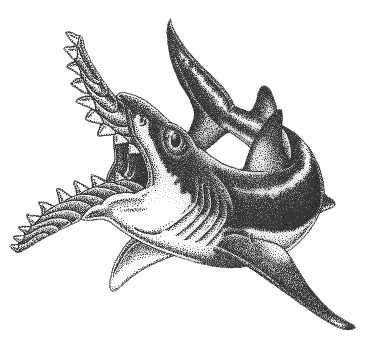
Scapanorhynchus


Name: Scapanorhynchus (Spade snout).
Phonetic: Skap-an-o-rink-us.
Named By: Woodwood - 1889.
Classification: Chordata, Chondrichthyes, Elasmobranchii, Selachimorpha, Mitsukurinidae.
Species: S. praeraphiodon, S. rapax, S. raphiodon, S. texanus.
Diet: Carnivore/Piscivore.
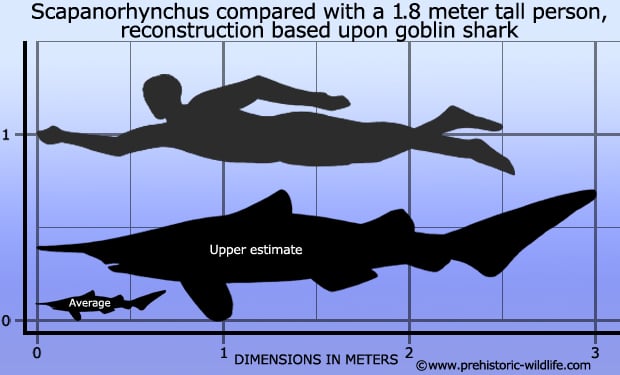
Size: Specimens indicate a length of approximately 65 centimetres, but some larger fossil teeth hint at a much larger size of up to 3 meters long.
Known locations: Worldwide.
Time period: Aptian through to the Maastrichtian of the Cretaceous. May have survived into the early Paleogene.
Fossil representation: Usually just the teeth, some complete body impressions are also known.
       Scapanorhynchus appears to have been so much like the living goblin shark (Mitsukurina owstoni) that the two were considered by some to be the same genus. However study of the teeth has brought the conclusion that while very similar, they are different enough to keep the two separated.
       The most striking feature of Scapanorhynchus is the extended snout that projects forward well ahead of the jaws. This snout was probably filled with electro-receptive ampullae that sensed the movements of nearby fish. This indicates that like the goblin shark, Scapanorhynchus was a deep water species that hunted in the darkness where sunlight could not penetrate. Here vision would be useless, but he electric sensors of its snout would easily find prey as it swam about, possibly unaware of the presence of Scapanorhynchus.
       Aside from generally being considered to be smaller than the goblin shark, Scapanorhynchus has quite different fins. The main difference here is the proportionately larger tail fin the superior (upper) lobe of which was huge in comparison to the bottom lobe. Not only does this indicate that Scapanorhynchus was not a strong open water swimmer, it also suggests that it probably just lurked in the darkness waiting for prey, perhaps near the bottom.
       Although usually considered to be small, the teeth of S. texanus have been measured at around five centimetres. This makes them a similar size to the teeth of the goblin shark which has been recorded at almost three and a half meters in length. However because of this large size and the fact that the teeth have been recovered from what appears to have been a relatively shallow water environment, some researchers have questioned its inclusion within the Scapanorhynchus genus.

Source : http://www.prehistoric-wildlife.com

Wednesday, January 1, 2014

Huge Flying Reptiles Ate Dinosaurs


Top 10 Terrifying Prehistoric Sea Monsters

Edwardchristhoper.blogspot.com - The modern ocean is a scary place, filled with barracuda, sharks, super-squids, and possibly Cthulhu. However, no matter what we find in the depths these days, none of them seem to come close to the giant terrors that roamed the seas in Earth’s past; giant sea-lizards, monster sharks and even “hypercarnivorous” whales. For most of these things, humans would barely qualify as a snack.
Here are 10 of the scariest prehistoric sea monsters to ever call the ocean home in prehistory.

10. Megalodon

Megalodon
Megalodon is probably the best-known creature in the list; it’s hard to keep the idea of a shark the size of a school bus out of pop culture. Plus, science-minded entertainment sources like the Discovery Channel love creatures that could pass for a movie monster. Despite the popular idea that Megalodon coexisted with dinosaurs, they lived from 25 to 1.5 million years ago, meaning that at best they missed the last dinosaur by 40 million years. On the other hand, this meant they might have still been around for the first humans. Eek.
Megalodons swam the warm oceans that were around until the last ice age in the early Pleistocene, which may have robbed them of their breeding grounds and food. Sometimes, it seems nature has our back.

9. Liopleurodon

Liopleurodon
If Jurassic Park had an aquarium scene, and actually featured more animals from the Jurassic period, liopleurodon probably would have been in it. Although the actual length of these beasts is contested (some scientists have claimed lengths in excess of 50’), most agree that it was around 20 feet in length, with a full fifth of that being pointy-toothed head. When the mouth of the “smaller” estimate is still plenty large to eat you whole, I think that is perfectly huge enough.
Scientists have tested the paddle design of these creatures on small swimming robots and found that although they would not have been incredibly fast, they were incredibly agile. They also would have been able to make short, fast burst attacks like crocodiles, which in no way makes them any less intimidating.

8. Basilosaurus

Basilosaurus
Despite the name and appearance, that is not a reptile, but actually a whale (and not even the most fearsome on the list!) Basilosaurs were predatory ancestors of modern whales, and could be 50 to 85 feet long! It is described as being the closest a whale has ever come to being a snake because of how long and sinuous it was. Imagine swimming in the ocean with an 80+ foot long alligator-snake-whale. Now imagine being afraid to even take a bath ever again.
Physical evidence suggests that basilosaurus did not have the cognitive ability of modern whales, nor the ability to echolocate, and could only navigate in 2 dimensions (so no deep diving or breaching). So at least this monster whale was dumber than a bag of prehistoric hammers and could not chase you if you dove or scrambled out on dry land, probably forever.

7. Jaekelopterus rhenaniae

Jaekelopterus rhenaniae
Nothing about the words “sea scorpion” are comforting to begin with, so this should not come off as too awful: this was one of the two largest arthropods to have ever lived, reaching a length of over 8 feet of armored, clawed horror. Most of us freak out at the thought of inch-long ants and foot wide spiders, so it’s easy to imagine screaming like a little girl if you ever stumbled across a living one of these.
On the plus side, sea scorpions (Euripterids) have been extinct since before the dinosaurs, having been wiped out in the Permian Triassic extinction event (which killed 90% of all life on earth) and are only survived, to some degree, by horseshoe crabs, which are even less formidable than regular crabs. There is no evidence that any sea scorpions were actually venomous, but the structure of their tail is similar to a modern scorpion’s, so it might have been.

6. Mauisaurus

Mauisaurus
Mauisaurus was named after the Maori god Maui, who pulled the islands of New Zealand up from the sea floor with a fish hook, so already you know this thing is going to be enormous. The neck of Mauisaurus measured up to 49 feet long; the longest proportionate (and really, “actual”) neck of any living thing aside from some sauropod dinosaurs. Their overall length was about 66 feet, and that ridiculously long neck had plenty of vertebrae, implying that it was flexible. Imagine a snake strung through a sea turtle with no shell, and you have an approximate idea of what this thing looked like.
It lived back in the Cretaceous era, meaning that creatures that jumped in the water avoid Velociraptors and Tyrannosaurs had to contend with these; the jury is out on which is worse. As far as science can tell, Mauisaurus was limited to the New Zealand area, showing that the area that would one day become Australia and its neighbors was always a land of terror.
ADVERTISEMENT

5. Dunkleosteus

Dunkleosteus
Dunkleosteus was a 30 foot long carnivorous tank. It was outlasted by sharks, but I am sure that is small consolation for the variety of creatures this beast ate. Instead of teeth, it had bony ridges, like a turtle. It has been calculated that they had a bite force of 8,000 pounds per square inch, putting it on par with crocodiles and T-Rex in terms of being history’s strongest biters. They also believe, based on the evidence in the skull regarding its musculature, that it could have opened its mouth in one fiftieth of a second, meaning it vacuumed food into its guillotine of a mouth.
The plates that made up the “teeth” changed as the fish aged from a solid, rigid jaw to segments that allowed it to hold prey easier, and made it more effective in biting through the bony plate armor of other armored fish. In the arms race that was the prehistoric ocean, Dunleosteus was a predatory super tank.

4. Kronosaurus

Kronosaurus
Kronosaurus is another short-necked pliosaur (like Liopleurodon up at number 9), and like Liopleurodon, its overall length has been contested. It was a “mere” 30 feet long and the longest teeth in its massive mouth were up to 11 inches long. This is why it was named after Cronus, the king of the old Greek Titans.
Guess where it lived? If you guessed “Australia”, then you  have been paying attention to life (and are correct). The head was up to 9 feet long. They could eat an entire modern man whole, and still have room left over for half of another. It has also been suggested that since their flippers are so similar in design to those of modern sea turtles, that they may have crawled out onto land to lay eggs. You can be sure no one was digging up these thing’s nests to get at the eggs.

3. Helicoprion

Helicoprion
These sharks grew to be about 15 feet long, and had a lower jaw that was made of a “tooth whorl”. It looks like a cross between a circular saw and a shark, and when you mix apex predators with power tools, the world quakes in fear.
Helicoprion’s teeth were serrated, implying that they were definitely carnivores, but there is some debate as to whether their teeth were in the front of the mouth, as shown in the picture, or if they were farther back, which would suggest a softer diet, like jellyfish. However it was arranged, it clearly worked; Helicoprion survived the Permian Triassic extinction, which means they may have been smart enough to create bomb shelters. Or maybe they just lived in the deep sea.

2. Livyatan melvillei

Livyatan melvillei
Remember me mentioning “hypercarnivorous” whales? Well here it is. Imagine a cross between an orca and a sperm whale. Livyatan melvillei was a whale that ate other whales. It had the largest teeth of any animal to ever use their teeth to eat (elephant tusks are bigger, but they just look impressive and help them smash things; they don’t eat with them) topping out at 1.18 feet. They lived in the same oceans and ate the same food as the Megalodon, so this whale actually had to compete with the largest predatory shark ever.
Not to mention their head was 10 feet long and featured the same echo-locating equipment as modern toothed whales, making them much more effective in murky water. In case it was not obvious, this beast was named after the leviathan, a giant sea monster from the bible, and Herman Melville, who wrote Moby Dick. If the great white whale had been one of these, it would have eaten the Pequot and everyone aboard as a snack.

1. Giant Stingray

Giant Stingray
What grew 17 feet across, had a 10 inch poison spike in its tail and was strong enough to drag a boat filled with people? In this case, a prehistoric super-fish that is still lurking around in fresh and brackish waters from the Mekong river to northern Australia. Stingrays have been around since a few million years after the dinosaurs died out, and have proven to be a successful design, much like the sharks they descended from.
The giant stingrays use that tried and true ancient design, but have somehow managed to survive ice ages and even the catastrophic Toba event. They were featured on Animal Planet’s River Monsters, and despite the host’s tendency to exaggerate damn near everything, they are incredibly dangerous to fool around with, even if you don’t know you are fooling around with one. They are notorious for putting their neurotoxin covered spike completely through limbs. I guess, on the plus side, if there is one, at least they won’t try to eat you.
David Dietle

Our friends at list25.com have posted a similar list of sea creatures.

Source :http://www.toptenz.net
Falcatus.

Edwardchristhoper.blogspot.com - Falcatus was a one-foot-long stethacanthid shark which ate shrimp.

Falcatus had a hook-shaped crest which only the males had. The crest could have been for attracting a female. But like all stethacanthids, the use for the crest is unknown. Stethacanthid means "spiny crest."

Falactus lived during the Carboniferous Period and probably had to avoid Edestus and Helicoprion.

Falcatus was the most abundant shark in the Bear Gulch Beds in Montana, and individuals have been found everywhere there. But sometimes whole schools of Falcatus have been preserved.


Falcatus isn't the only animal with the word "falcatus" in its name. There's also Parexus falcatus.  The binomial name of Falcatus is Falcatus falcatus.


The female Falcatus looked more like Cladoselache than Falcatus. The difference between the male Falcatus and the female Falcatus is that the female did not have the crest or the triangle patch of barbs on the head. The male also had a longer snout than the female.

Falcatus was probably a visual predator because of its huge eyes, which were almost the size of its head.


Source : http://www.lifebeforethedinosaurs.com

Friday, December 27, 2013

Xenacanthus

xenacanthus

Name:

Xenacanthus (Greek for "foreign spike"); pronounced ZEE-nah-CAN-thuss

Habitat:

Oceans worldwide

Historical Period:

Late Carboniferous-Early Permian (310-290 million years ago)

Size and Weight:

About 2 feet long and 10-20 pounds

Diet:

Marine animals

Distinguishing Characteristics:

Slender, eel-shaped body; spine jutting from back of head

About Xenacanthus:

As prehistoric sharks go, Xenacanthus was the runt of the aquatic litter--the numerous species of this genus measured only about two feet long, and had a very un-shark-like body plan more reminiscent of an eel. The most distinctive thing about Xenacanthus was the single spike protruding from the back of its skull, which some paleontologists speculate carried poison--not to paralyze its prey, but to deter larger predators. For a prehistoric shark, Xenacanthus is very well represented in the fossil record, because its jaws and cranium were made of solid bone rather than easily degraded cartilage, as in other sharks.

Source : http://dinosaurs.about.com

Xiphactinus Audax Xiphactinus audax

Image: A Xiphactinus
Edwardchristhoper.blogspot.com - Xiphactinus was a fast, strong swimmer and may have leapt from waters to dislodge parasites from its skin. It is also possible that there were lots of little fish that swarmed around it, nibbling on parasites, much the same as they do today for larger fish.
Copyright © MMVII NGHT, Inc.

Fast Facts

Type:
Prehistoric
Diet:
Carnivore
Size:
Length, up to 17 ft (5 m)
Protection status:
Extinct
Did you know?
A Xiphactinus on display at a museum in Kansas has a complete, well-preserved fish inside it. Scientists believe the struggling prey ruptured an organ of its captor as it was swallowed, killing the larger fish.
Size relative to a bus:
Illustration: Xiphactinus audax compared with bus
Xiphactinus was one of the largest bony fish of the Late Cretaceous and is considered one of the fiercest creatures in the sea. A powerful tail and winglike pectoral fins shot the 17-foot-long (5-meter-long) monster through the surface waters of the ocean. Unlucky fish and unsuspecting seabirds were snared inside Xiphactinus's upturned jaw, which was lined with giant, fanglike teeth, giving it an expression akin to that of a bulldog.
A 13-foot-long (4-meter-long) Xiphactinus could open its jaw wide enough to swallow six-foot-long (two-meter-long) fish whole, but it itself was occasionally prey to the shark Cretoxyrhina.
Xiphactinus trolled an ancient ocean called the Western Interior Seaway, which covered much of central North America during the Cretaceous. Though long extinct, if alive today the bony fish would look like a giant, fanged tarpon.

Source : http://animals.nationalgeographic.com

Giant orthocone


Giantorthocone closeup
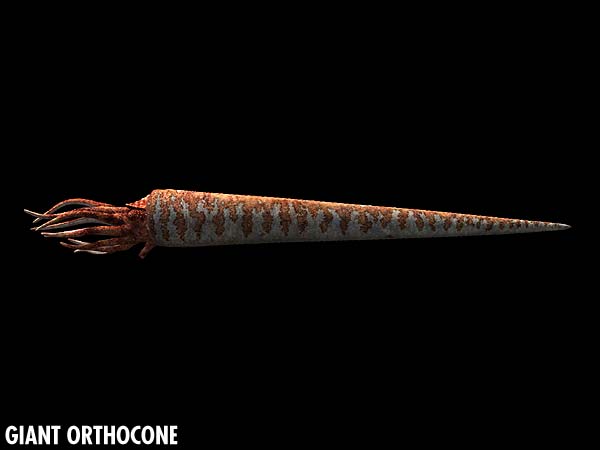
Edwardchristhoper.blogspot.com - A Giant Orthocone was a nautilus that resembled a squid in an ice-cream cone. It was also related to modern-day squids. They existed 470-440 million years ago in the Ordivician period. Though they had bad eyesight, it did not matter as they lived deep, where most creatures could not see them coming. They had crushing tentacles at up to 6 feet long and ate anything it could, including sea scorpions. It was the top predator of the Ordivician seas.

Source : http://seamonsters.wikia.com

Stethacanthus – a prickly-finned shark (ste-tha-can-thuss)


Model of Stethacanthus altonensis.
Image: Jon Augier
Source: Museum Victoria
Carboniferous

HOW BIG IT WAS

Stethacanthus relative size depiction as described below
Stethacanthus was about 70 cm long.
This odd-looking shark lived in shallow coastal waters 350 million years ago, feeding on fish, cephalopods and crustaceans. The purpose of the strangely-shaped fin and spiked forehead of Stethacanthus is uncertain – they may have played a role in courtship or as a visual threat.

Source : http://museumvictoria.com.au

Thursday, December 26, 2013

Prehistoric ghost shark Helicoprion’s spiral-toothed jaw explained

Edwardchristhoper.blogspot.com - After a century of colourful guesses, CT scans have revealed what’s really going on inside the nightmarish jaw of Helicoprion, a large, 270 million-year-old cartilaginous fish with an elaborate whorl of teeth set in the middle of its mouth.
In 1899, Russian geologist, Alexander Petrovich Karpinsky, gave this six-metre-long fish the name Helicoprion, meaning “spiral saw”, based on a fragmentary fossil found in Kazakhstan. Because the saw he was describing had been separated from the rest of the body, Karpinsky couldn’t be sure where it would have fit, so initially he suggested that it started in the fish’s mouth, and curled upwards along the snout as an external coiled mass of fused-together teeth. Think a sawfish’s saw, only curled upwards. Further guesses were made during the early 1900s by a number of researchers from around the world, including American palaeontologist Charles Rochester Eastman. Eastman had issues with the idea that such an unwieldy apparatus could have possibly sat inside this poor creature’s face. Publishing in a 1900 edition of The American palaeontologist, Eastman favoured the idea that the whorl protruded from somewhere along the length of the fish’s back, acting as some sort of defensive display, perhaps.
Helicoprion
The many faces of Helicoprion. Reconstructions of Helicoprion since 1899. Earliest models (a – d) posited the whorl as an external defensive structure, but feeding reconstructions dominate more recent hypotheses. Artwork © Ray Troll 2013.
A few years later, Karpkinsky followed Eastman’s train of though, and suggested that the Helicoprion’s whorl could have formed part of the animal’s tail, or perhaps extended from its dorsal fin, or sat lower down on its back. In 1907, American ichthyologist, Oliver Perry Hay, found a fossilised specimen that was still sitting in its natural position, and judging from this, favoured the jaw theory. But did it sit in the upper or lower jaw? And did it sit in both? Such questions were impossible to answer with the few and fragmentary specimens these researchers had to work with.
Regardless, the general consensus in the earliest hypothetical reconstructions of Helicoprion was that this terrible, toothy whorl surely served a defensive purpose. Later this century, this perception has changed, and researchers moved towards the idea that the whorl was used mainly for feeding, and therefore was associated with the creature’s jaw.


Helicoprion
A recent reconstruction of Helicroprion with the tooth whorl sitting inside the mouth like a tongue. Credit: Mary Parrish, Robert Purdy, Victor Springer and Matt Carrano from the Smithsonian National Museum of Natural History
In 1950, a crucial Helicoprion whorl specimen was discovered by Danish palaeontologist Svend Erik Bendix-Almgreen in the Waterloo Mine near Montpelier, Idaho. Named IMNH 37899 and housed in the Idaho Museum of Natural History, it was first described by Bendix-Almgreen in 1966. It might have been seriously crushed and disarticulated, but along with the 117 discernible serrated tooth crowns sitting on a spiral with a diameter of 23 cm was some very telling cranial cartilage. This proved for the first time that at least some of the whorl was contained inside Helicoprion’s mouth.
But that didn’t limit the possibilities. Over the past fifty years, researchers have suggested that the whorl extended awkwardly from the lower lip, curling underneath the chin; sat inside the mouth where the tongue should be; or perhaps sat further down towards the throat.
Helicoprion
Leif Tapanila with two of the largest Helicoprion whorls in the world. Credit: Ray Troll
Now a team led by Leif Tapanila from the Department of Geosciences at Idaho State University, and curator of the Idaho Museum of Natural History, have gained unprecedented insight into the structure of Helicoprion’s skull. IMNH 37899 was scanned using an ACTIS scanner at the University of Texas High-Resolution X-ray CT Facility, and from this, a scaled, 3-D computer-generated model of the animal’s skull was generated.
“Our reconstruction posits that the tooth whorl is a singular, symphyseal [fused] structure of the lower jaw that occupied the full length of the mandibular arch,” the team reported in Biology Letters yesterday. This means that instead of extending past the lower jaw and coiling underneath the chin, as had been previously suggested, the whorl grew inside the lower jaw. This way, just as sharks have multiple rows of teeth that are continuously replaced, Helicoprion had a partly concealed tooth factory that began near the area where the upper and lower jaws meet, ran over the mouth wear the tongue would be if it had one, and then into the cartilage supported by the lower jaw (see first image).
“Continual growth of the whorl pushes the tooth–root complex in a curved direction towards the front of the jaw, where it eventually spirals to form the base of the newest root material, and this process continues to form successive revolutions,” the researchers say. “At some time, prior to a complete 360 degree evolution of spiral growth, tooth crowns are concealed within tessellated cartilage on the upper jaw.”
As Helicoprion didn’t have any teeth on his upper jaw, the team suggests that the predatory fish would have broken down its soft-bodied prey, such as cephalopods and small fish, by repeatedly slicing them with a single row of serrated teeth. When it closed its closed its lower jaw, the whorl of teeth were pushed backwards, “providing an effective slicing mechanism for the blade-like serrated teeth and forcing food to the back of the oral cavity”.

Tapanila and colleagues suggest that the Helicoprion’s jaw could have extended past 50 cm long, and some tooth whorls would have boasted some 150 teeth. The team also says that the creature is not a shark, as others have assumed, but a chimaera (Holocephalan), which is a group of cartilaginous fish also known as ratfish or ghost sharks that branched off from the sharks 400 million years ago. “It was always assumed that the Helicoprion was a shark, but it is more closely related to ratfish, a Holocephalan,” says Tapanila. “The main thing it has in common with sharks is the structure of its teeth, everything else is Holocephalan.”

Source : http://blogs.scientificamerican.com

Thursday, December 5, 2013

Temnodontosaurus


Name: Temnodontosaurus ‭(‬Cutting-toothed lizard‭)‬.
Phonetic: Tem-noe-don-toe-sore-us.
Named By: Richard Lydekker‭ ‬-‭ ‬1889.
Classification: Chordata,‭ ‬Reptilia,‭ ‬Diapsida,‭ ‬Ichthyopterygia,‭ ‬Ichthyosauria,‭ ‬Temnodontosauridae.
Species: T.‭ ‬platyodon‭ (‬type‭)‬,‭ ‬T.‭ ‬eurycephalus,‭ ‬T.‭ ‬nuertingensis,‭ ‬T.‭ ‬trigonodon,‭ ‬T.‭ ‬acutirostris.
Diet: Cephalopods like ammonites.
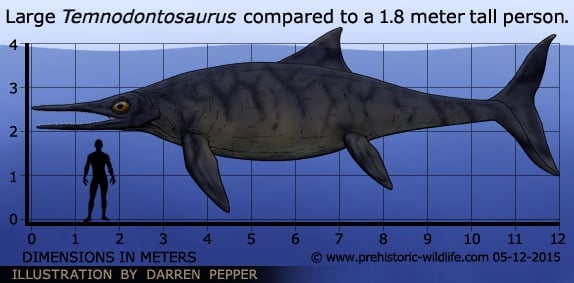
Size: Up to‭ ‬12‭ ‬meters long.
Known locations: Europe including British Isles and Germany.
Time period: Hettangian through to Toarcian of the Jurassic.
Fossil representation: Several specimens.
       Edwardchristhoper.blogspot.com - Temnodontosaurus is one of the oldest and largest ichthyosaurs known to science,‭ ‬and while there are a few species associated with the genus,‭ ‬the most obvious differences between these are the size and proportions of the jaws.‭‬Temnodontosaurus fossils have been so well preserved that they reveal stomach contents of ammonites and cephalopods like squid.‭ ‬Juvenile specimens have also been reported inside Temnodontosaurus remains,‭ ‬but in a position that suggests they were waiting to be born rather than being digested.‭ ‬Live birth in ichthyosaurs like Temnodontosaurushas long been suspected as their fusiform bodies that are so much like fish would make it impossible for them to climb onto land.‭ ‬Like most large ichthyosaurs,‭ ‬Temnodontosaurus is thought to have been a marine reptile of deep water,‭ ‬mostly rising to the surface just to breathe in fresh air.
       Temnodontosaurus had large eyes that were roughly twenty centimetres across.‭ ‬These large eyes would have enabled Temnodontosaurus to see better when in deep water where most of the above sunlight could not penetrate.‭ ‬The large eyes providing a greater catch area for the little available light would allow Temnodontosaurus to distinguish ammonite forms against the dim oceanic backdrop.‭ ‬Aside from ammonites found inside Temnodontosaurus fossils,‭ ‬further support for this hunting behaviour comes from study of the teeth which reveals that they had robust roots so that they could withstand the stresses of cracking shells without breaking off.‭
       Ammonites would have been a plentiful food supply back in the Jurassic oceans,‭ ‬and one that could not have required a great amount of energy expenditure to catch.‭ ‬This suited the large body of Temnodontosaurus as it would require large amounts of a stable food supply to keep going.‭ ‬It is hard to say how the large size came about however but a larger body can carry more oxygen for Temnodontosaurus to stay hunting down in the depths for longer.‭ ‬It‭’‬s possible that the earlier ancestors of Temnodontosaurus came across the plentiful supply of deep water cephalopods and grew larger to take better advantage of it.‭ ‬However this greater size also brought a greater reliance upon them,‭ ‬a specialisation that could bring the end of the genus with the disappearance of the prey.

Source : http://www.prehistoric-wildlife.com

Monday, December 2, 2013

Kerangka Dinosaurus Langka Dijual Rp7,8 miliar

Thumbnail


Sabtu, 30 November 2013 WIB
Edwardchristhoper.blogspot.com - London: Kerangka dinosaurus diplodocus yang 160 juta tahun lalu menghuni wilayah yang kini Amerika Serikat dijual dengan harga sekitar 651.100 dolar AS atau sekira Rp7,8 miliar dalam satu lelang di Inggris.

Rumah lelang Summers Place Auction menolak memberikan rincian tentang pembeli kerangka dinosaurus yang tak ingin identitasnya diketahui.

Pelelang hanya menyatakan bahwa dinosaurus yang disebut dengan nama Misty itu selanjutnya akan dipamerkan ke publik.

Dinosaurus langka itu ditemukan oleh putra pemburu dinosaurus asal Jerman, Raimund Albersdoerfer, di pertambangan Dana di Wyoming, Amerika Serikat bagian Barat.

"Menemukan kerangka diplodocus yang sangat lengkap seukuran ini sangat langka," kata Errol Fuller, ahli sejarah dan kurator penjualan.

Sisa kerangka dinosaurus sepanjang 17 meter itu termasuk di antara kerangka diplodocus yang kurang lebih lengkap yang pernah ditemukan.

Anak-anak ahli paleontologi Jerman menemukan fosil kerangka Misty setelah ayah mereka mengirim mereka untuk memburu ke area yang lain karena mereka mengganggu pencarian yang sedang dilakukan sang ayah.

"Anak-anak ingin menemukan potongan mereka sendiri, jadi dia mengirim mereka untuk menemukan sedikit fragmen namun tidak benar-benar penting, dan mereka kembali dan mengatakan mereka menemukan tulang yang sangat besar ini," kata Fuller.

Karena kerangka itu ditemukan di lahan pribadi dan bulan tanah federal, ada kemungkinan paleontolog Jerman memindahkannya dari Amerika Serikat.

Mereka dipindahkan ke Belanda tempat mereka dibersihkan dan disusun lalu dibawa ke Inggris tempat Misty dijual ke pemilik yang akan membawanya ke rumah baru. (Antara)

Editor: Asnawi Khaddaf

Sumber : http://www.metrotvnews.com