Temnodontosaurus

Megalodon

Mobil James Bond bakal Disulap Jadi Mobil Selam Sungguhan

XL Bidik 40 Persen Pelanggan Gunakan E-Channel

Idm 6.17 Full Version Download With Patch 100% working.

Showing posts with label Space. Show all posts

Tuesday, January 7, 2014

Top 10 Strangest Things In Space

Edwardchristhoper.blogspot.com - Let’s be honest: space is an absolutely crazy place. Most science fiction writers throw in a planet with two stars that looks vaguely like Southern California, and call it a day. But the cosmos is a lot stranger than we give it credit for:


10.Hypervelocity Stars
Shoot 575
Everyone knows that shooting stars are just meteors entering the atmosphere, right? If you didn’t, congratulations—you just failed the fourth grade. What some people don’t know, however, is that real shooting stars exist as well; they’re called hypervelocity stars. These are big, fiery balls of gas rocketing through space at millions of miles per hour.
When a binary star system is gobbled down by the supermassive black hole (that’s the scientific term, by the way) at the center of a galaxy, one of the two partners is consumed, while the other is ejected at high speed. Just try to imagine a huge ball of gas, four times the size of our sun, hurtling out from our galaxy at millions of miles per hour.


9.The Planet From Hell
Gliese581C Forest04
Gliese 581 c wants to kill you. Seriously. Scientists have determined that this hell of a planet is the most likely candidate for future colonization, despite the fact the entire planet’s out to get you.
This planet orbits a red dwarf star, many times smaller than our Sun, with a luminosity of only 1.3% of our sun. This means that the planet is far closer to its star than we are to ours. Because of this, it is stuck in a state of tidal locking, meaning that one side of the planet is always facing the star, and one side is always facing away—just like our moon’s relationship with Earth.
The tidal locking of the planet alone results in some pretty odd features. Stepping out onto the star-side of the planet would immediately melt your face off, whereas standing on the opposite side of the planet, where there is no sun, would freeze you instantly. However, in between these two extremes is a small belt where life could theoretically exist.
Living on Gliese 581 c would have its challenges, though. The star it orbits is a Red Dwarf, which means that it is at the lower frequency end of our visible spectrum, bathing the entire sky of Gliese 581 c in a hellish red color. Another side effect of this is the fact that photosynthesizing plants would have to adapt to the constant bombardment of infrared radiation, rendering them a deep black color. That Greek salad wouldn’t seem so appetizing any more…


8.The Castor System
A-World-With-Twin-Sunrises-2
As if one or two giant, fiery balls of gas weren’t enough, here we have the Castor System. As one of the two bright stars from the Gemini constellation in our night sky, it has some serious luminosity. This is because the Castor System isn’t one, or two, but six stars, all orbiting around a common central mass.
Three binary star systems orbit each other here, with two hot and bright A-Type stars being stuck in the system, as well as four M-type red dwarves. All together, though, these six stars put out roughly 52.4 times more luminosity than that of our sun.


7.Space Raspberries and Rum
Sagb
For the last few years, scientists have been studying a dust cloud near the center of our Milky Way galaxy. If there’s a God out there, it seems that he decided to get creative—this dust cloud, named Sagittarius B2, smells of rum and tastes like raspberries.
The gas cloud in question consists largely of ethyl formate, which is known to give raspberries their taste, and rum its distinctive smell. This large cloud is said to contain a billion, billion, billion liters of the stuff—which would be great, if it wasn’t rendered undrinkable by pesky particles like propyl cyanide.
The creation and distribution of these more complex molecules is still a mystery to scientists, however, so we won’t be opening up an intergalactic pub anytime soon.


6.A Planet of Burning Ice
Ogle Planet
Do you remember Gliese? That hell-hole of a star that we visited earlier? We’re heading back to the same solar system for this one. As if one murderous planet wasn’t enough, Gliese supports a planet made almost entirely out of ice—at 439 degrees Celsius.
Gliese 436 b is, quite simply, a burning ice cube. Imagine Hoth from Star Wars—except that it’s on fire. The only reason this ice stays solid is because of the huge amount of water present on the planet; the gravity pulls it all in towards the core, keeping the water molecules so densely packed that they cannot evaporate.


5.The Diamond Planet
Sig11-013 Med
Finally: a planet fit for Oprah, or perhaps even Bill Gates. 55 Cancri e—made entirely out of crystallized diamond—would be priced at 26.9 nonillion dollars. That’s the kind of stuff that even the Sultan of Brunei dreams about at night.
The huge diamond planet was once a star in a binary system, until its partner began to cannibalize it. However, the star was not able to pull its carbon core away, and carbon is just a ton of heat and pressure away from being a diamond—so at a surface temperature of 1648 degrees Celsius, the conditions are almost perfect.
One third of the mass of the planet is said to be pure diamond, and whereas Earth is covered in water and abundant in oxygen, this planet is made mainly of graphite, diamond, and a few other silicates.
The huge gemstone is two times the size of Earth, and has eight times the mass, making it a “Super-Earth.”


4.The Himiko Cloud
Himiko-Lyman-Alpha-Blob
If there has ever been any object that has shown us the origins of a primordial galaxy, this is it. The Himiko Cloud is the most massive object ever found in the early universe, and it dates to only 800 million years after the Big Bang. The Himiko Cloud astounds scientists with its sheer size, roughly half that of our Milky Way Galaxy.
Himiko belongs to what is known as the “reionization epoch,” or the period from around 200 million to one billion years after the Big Bang—and it’s the first glimpse scientists have managed to get of the early formation of galaxies. To make it even cooler, it has been introduced as the “Giant Mystery Blob Discovered Near the Dawn of Time” by Space.com.


3.The Universe’s Largest Water Reservoir
Young-Black-Hole-Quasar 17130 600X450
Twelve billion light years away, the universe’s largest water reservoir resides in the heart of a quasar. Containing 140 trillion times the amount of water in Earth’s oceans, and found near the colossal black hole at the center of the quasar, the water unfortunately manifests itself in the form of a massive cloud of gas, several hundred light years in diameter—our dreams of the universe’s most kick-ass water slide have been destroyed!
But the kicker is that this black hole, twenty billion times the size of our sun, is constantly spewing out huge amounts of energy—equivalent to what would be produced by 1000 trillion suns.


2.The Universe’s Largest Electrical Current
Image-2
Only a few years ago, scientists stumbled upon an electrical current of cosmic proportions: 10^18 amps, or roughly one trillion lightning bolts. With that kind of power, you could even use that pesky seven-blade electric razor you have lying around!
The lightning is thought to originate from an enormous black hole in the center of the galaxy, which has a core that is supposedly a “huge cosmic jet.” Apparently, the black hole’s huge magnetic field allows it to fire up this lightning bolt through gas and dust to a distance of over one hundred and fifty thousand light years away. And we thought that our galaxy was big—this single lightning bolt is one and a half times the size of it.


1.The LQG
Artist's Redering Ulas J1120+0641
So yeah, the Himiko Cloud is pretty big—like, half the size of our galaxy. Big whoop, right? Well, what about a structure in space so enormous that it breaks the conventional laws for modern astronomy? This structure, my friends, is the LQG—the Large Quasar Group.
Our galaxy, the Milky Way, is only one hundred thousand light years across. Think about that for a moment; if something happens on the far side of the galaxy, it would take a hundred thousand years for the light to reach the opposite end. That means that when we watch an event take place at the other end of our galaxy, it actually occurred when the human species was just beginning to form.
Now, take that length of time, and multiply it by forty thousand. That’s right—the Large Quasar Group is four billion light years across. The cluster of seventy-four quasars actually breaks the rules of standard astrophysics, since the maximum size of any cosmic structure should be only 1.2 billion light years across.

Scientists have absolutely no idea how this huge structure formed, since they had previously only been aware of other clusters of perhaps several hundred million light years across. The gargantuan structure absolutely spits on a certain physical law, which states that when viewed from a distance, the universe would look relatively uniform. This is exactly the type of condescending cosmic structure that looks over at our galaxy and, with a smirk, says “cute.”

Source : http://listverse.com

Monday, December 2, 2013

Komet ISON mungkin Bertahan setelah Lewati Matahari


Minggu, 1 Desember 2013 WIB

Edwardchristhoper.blogspot.com -  Jakarta: Komet ISON kemungkinan masih bertahan setelah melintasi matahari karena materinya tampak pada sisi lain matahari pada petang hari 28 November 2013 meski tidak terlihat selama berada pada posisi terdekat dengan matahari.

ISON yang tampak redup dan mendesis tampak dalam beberapa pengamatan namun kemudian sama sekali tidak bisa dilihat oleh Solar Dynamics Observatory NASA atau observatorium surya di Bumi. Beberapa ilmuwan yakin komet itu sepenuhnya sudah hancur.

Namun demikian, satu rentetan materi terang yang mengalir dari matahari terlihat dari observatorium Badan Antariksa Eropa (European Space Agency/ESA) dan Solar and Heliospheric Observatory Badan Antariksa Amerika Serikat (NASA) pada petang hari.

Masih ada pertanyaan apakah itu puing-puing komet atau sebagian dari bagian inti komet yang bertahan, demikian menurut artikel di laman resmi NASA.

Analisis ilmuwan dari Comet ISON Observing Campaign menunjukkan bahwa setidaknya satu inti masih utuh.

"Saat ini terlihat setidaknya sebagian kecil pecahan ISON tersisa dalam satu potongan dan secara aktif melepaskan material," tulis Karl Battam, ahli astrofisika di Naval Research Laboratory di Washington.

"Jika ada satu inti, masih terlalu dini untuk mengatakan seberapa lama itu akan bertahan. Jika memang bisa bertahan lebih dari beberapa hari, terlalu dini untuk mengatakan komet itu akan terlihat di langit malam. Kalaupun terlihat di langit malam, masih terlalu awal untuk mengatakan akan seberapa terang," jelas dia.

Sepanjang tahun selama para peneliti mengamati Komet ISON dan khususnya selama pendekatan terakhirnya ke matahari--komet menjadi terang dan redup dalam cara yang tak terduga.

Sejak ditemukan oleh astronom amatir International Scientific Optical Network (ISON) Rusia pada September 2012, komet ISON memberikan banyak kejutan.

Awalnya komet itu sangat terang untuk komet yang berada jauh dari matahari sampai melampaui orbit Jupiter.

Saat mendekat komet itu tidak menjadi lebih terang seperti yang diperkirakan, meningkatkan keraguan tentang ukurannya dan jumlah air yang terkandung di dalamnya.

Gambar-gambar yang bertentangan terus terlihat sampai saat ISON mendekat ke matahari pada Kamis lalu. Ekor panjang dan intinya tampak menguap dalam tungku matahari.

Tapi pada akhir hari Kamis ISON memberikan kejutan lagi saat rentetan materinya mengalir dari arah matahari. (Antara)

Editor: Asnawi Khaddaf

Sumber : http://www.metrotvnews.com                                                                                           

Friday, November 29, 2013

Komet ISON Hancur setelah Kelilingi Matahari

Edwardchristhoper.blogspot.com - New York: Komet ISON hancur akibat panas yang sangat tinggi dan tekanan gravitasi  setelah mengelilingi Matahari, Kamis (28/11). Ada kemungkinan komet itu tidak dapat bertahan dalam perjalanan.

Sejumlah observatorium menyaksikan ISON berada pada titik paling dekat dengan Matahari atau perihelion. Ilmuwan untuk proyek SDO NASA, Dean Pesnell, mengatakan pihaknya tidak melihat komet ISON di SDO (Solar Dynamics Observatory).

"Jadi kami pikir itu (komet) pecah dan menguap sebelum mencapai perihelion," ujarny seperti dilansir dalam laman NASA.

Sebuah video yang dilansir Space.com memperlihatkan komet ini tidak terlihat dalam rekaman pengamatan  SDO.

Komet itu makin samar baik dalam pandangan observatorium Solar Terrestrial Relations Observatory NASA, Badan Antariksa Eropa dan Solar Heliospheric Observatory NASA.

Ini berarti komet ISON tidak akan terlihat di langit malam pada bulan Desember. (Ant)

Editor: Irvan Sihombing

Sumber : http://www.metrotvnews.com

Wednesday, November 27, 2013

Through the Wormhole : Are We Alone?

Edwardchristhoper.blogspot.com - For you all space lover, you must love this video, this is about Through the Wormhole with Morgan Freeman : Are We Alone? And here is the video


 Next time I'll show you the another episode

I think it is better to download this video with your IDM, so you can watch it without using the Internet.

Source : http://www.youtube.com

Through the Wormhole : How Did We Get Here

Edwardchristhoper.blogspot.com - For you all space lover, you must love this video, this is about Through the Wormhole with Morgan Freeman : How Did We Get here? And here is the video


 Next time I'll show you the another episode

I think it is better to download this video with your IDM, so you can watch it without using the Internet.

Source : http://www.youtube.com

Through the Wormhole : What Happened Before the Beginning

Edwardchristhoper.blogspot.com - For you all space lover, you must love this video, this is about Through the Wormhole with Morgan Freeman : What Happened Before the Beginning. And here is the video

 Next time I'll show you the another episode

I think it is better to download this video with your IDM, so you can watch it without using the Internet.

Source : http://www.youtube.com

Tuesday, November 26, 2013

Through the Wormhole : Is Time Travel Possible

Edwardchristhoper.blogspot.com - For you all space lover, you must love this video, this is about Through the Wormhole with Morgan Freeman : Is Time Travel Possible. And here is the video

Next time I'll show you the another episode

I think it is better to download this video with your IDM, so you can watch it without using the Internet.

Source : http://www.youtube.com

Through the Wormhole : The Riddle of Black Holes

Edwardchristhoper.blogspot.com - For you all space lover, you must love this video, this is about Through the Wormhole with Morgan Freeman : The Riddle of Black Holes. And here is the video

Next time I'll show you the another episode

I think it is better to download this video with your IDM, so you can watch it without using the Internet.

Source : http://www.youtube.com

Through the Wormhole : Is there a creator?

Edwardchristhoper.blogspot.com - For you all space lover, you must love this video, this is about Through the Wormhole with Morgan Freeman : Is there a creator? And here is the video

Next time I'll show you the another episode

I think it is better to download this video with your IDM, so you can watch it without using the Internet.

Source : http://www.youtube.com


Sunday, November 17, 2013

Gliese 581g Tops List of 5 Potentially Habitable Alien Planets

The large planet in the foreground is Gliese 581g, which is in the middle of the star's habitable zone and is only three to four times as massive as Earth.
This artist's conception shows the inner four planets of the Gliese 581 system and their host star. The large planet in the foreground is Gliese 581g, which is in the middle of the star's habitable zone and is only two to three times as massive as Earth. Some researchers aren't convinced Gliese 581g exists, however.
Credit: Lynette Cook
The controversial exoplanet Gliese 581g is the best candidate to host life beyond our own solar system, according to a new ranking of potentially habitable alien worlds.
Gliese 581g shot to the top of the list — which was published Thursday (July 19) by researchers at the University of Puerto Rico at Arecibo’s Planetary Habitability Laboratory (PHL) — after a new study marshaled support for its long-debated existence.
The exoplanet was discovered in September 2010, but other astronomers began casting doubt on its existence just weeks later. Now Gliese 581g's discoverers have rebutted their critics' charges in a new paper, and have done so effectively enough to get the PHL onboard.

Here's a brief rundown of the PHL's top five habitable alien planets:
Gliese 581g
This rocky world — if it does indeed exist — is just 20 light-years away from our solar system. It's likely two to three times as massive as Earth and zips around its parent star, the red dwarf Gliese 581, every 30 days or so. [Gallery: The Strangest Alien Planets]
This orbit places the planet squarely in the star's "habitable zone" — that just-right range of distances where liquid water, and perhaps life as we know it, could exist.
Gliese 581g has at least four, and possibly five, planetary neighbors. The team that spotted Gliese 581g also detected another planet, known as 581f, circling much farther away from the star. But scientists are still arguing about that world's existence, too.
An artist's conception of the alien planet GJ 667Cc, which is located in the habitable zone of its parent star.
Credit: Carnegie Institution for Science
Gliese 667Cc
Gliese 667Cc, which was discovered in February 2012 by the same core team that spotted Gliese 581g, orbits a red dwarf 22 light-years away, in the constellation Scorpius (The Scorpion).
The alien world is a so-called "super Earth" that's at least 4.5 times as massive as our planet, and it completes an orbit every 28 days. At least one other planet resides in the 667C system.
Gliese 667Cc's parent star is part of a triple-star system, so the planet's night sky would probably be a sight to behold.
Artist's Conception of Kepler-22b
This artist's conception illustrates Kepler-22b, a planet known to comfortably circle in the habitable zone of a sun-like star.
Credit: NASA/Ames/JPL-Caltech
Kepler-22b
Kepler-22b was spotted by NASA's planet-hunting Kepler space telescope, which has detected more than 2,300 potential exoplanets since its March 2009 launch. Only a small number have been confirmed so far, but the vast majority should end up being the real deal, researchers have said.
Kepler-22b, whose discovery was announced in December 2011, is a super Earth about 2.4 times as wide as our planet. If the greenhouse effect operates on Kepler-22b like it does on Earth, the alien world would have an average surface temperature of 72 degrees Fahrenheit (22 degrees Celsius), researchers have said.
The exoplanet is found about 600 light-years away, and it orbits a star very much like our own sun.
This artist’s impression shows the planet HD 85512b orbiting the Sun-like star HD 85512 about 35 light-years from Earth.
This artist’s impression shows the planet HD 85512b orbiting the Sun-like star HD 85512 about 35 light-years from Earth. This planet is about 3.6 times as massive as the Earth is at the edge of the habitable zone around the star, where liquid water, and perhaps even life, could potentially exist.
Credit: ESO/M. Kornmesser
HD 85512b
HD 85512b is another super Earth, one that's thought to be about 3.6 times as massive as our planet. The alien world is found about 35 light-years from us, in the direction of the constellation Vela (The Sail).
Astronomers announced the discovery of HD 85512b — and about 50 other alien planets spotted by the HARPS spectrograph on a telescope in Chile — in September 2011. The planet's estimated average surface temperature is 77 degrees Fahrenheit (25 degrees Celsius).
The orbits of planets in the Gliese 581 system are compared to those of our own solar system. The Gliese 581 star has about 30 percent the mass of our sun, and the outermost planet is closer to its star than we are to the sun. Gliese 581d might be able to sustain liquid water on its surface.
Credit: Zina Deretsky, National Science Foundation
Gliese 581d
This world, which is about seven times as massive as Earth, orbits a bit farther out than its planetary sibling Gliese 581g.
When 581d was first discovered in 2007, many scientists regarded it as too cold to be potentially habitable. In the years since, however, atmospheric-modeling studies have suggested that the planet may indeed be able to support life as we know it — provided 581d is warmed by a greenhouse effect.
To determine if this the case, researchers will likely need to study the planet's atmosphere directly. That sort of work could be years off, since it would probably require the development of new and advanced telescopes.

Source : http://www.space.com

Why Warp Drives Aren't Just Science Fiction

Starship From 'Star Trek'
The iconic starship from 'Star Trek,' the U.S.S. Enterprise. Depiction from the Star Trek: The Video Game.
Credit: Namco Bandai
Astrophysicist Eric Davis is one of the leaders in the field of faster-than-light (FTL) space travel. But for Davis, humanity's potential to explore the vastness of space at warp speed is not science fiction.
Davis' latest study, "Faster-Than-Light Space Warps, Status and Next Steps" won the American Institute of Aeronautics and Astronautics' (AIAA) 2013 Best Paper Award for Nuclear and Future Flight Propulsion.
TechNewsDaily recently caught up with Davis to discuss his new paper, which appeared in the March/April volume of the Journal of the British Interplanetary Society and will form the basis of his upcoming address at Icarus Interstellar's 2013 Starship Congress in August. [Super-Fast Space Travel Propulsion Ideas (Images)]

"The proof of principle for FTL space warp propulsion was published decades ago," said Davis, referring to a 1994 paper by physicist Miguel Alcubierre. "All conventional advanced propulsion physics technologies are limited to speeds below the speed of light … Using an FTL space warp will drastically reduce the time and distances of interstellar flight."
Warp speed: a primer
Before delving into Davis' study, here's a quick review of faster-than-light space travel:
According to Einstein's theory of special relativity, an object with mass cannot go as fast or faster than the speed of light. However, some scientists believe that a loophole in this theory will someday allow humans to travel light-years in a matter of days.
In current FTL theories, it's not the ship that's moving — space itself moves. It's established that space is flexible; in fact, space has been steadily expanding since the Big Bang.
By distorting the space around the ship instead of accelerating the ship itself, these theoretical warp drives would never break Einstein's special relativity rules. The ship itself is never going faster than light with respect to the space immediately around it.
Davis's paper examines the two principle theories for how to achieve faster-than-light travel: warp drives and wormholes.
The difference between the two is the way in which space is manipulated. With a warp drive, space in front of the vessel is contracted while space behind it is expanded, creating a sort of wave that brings the vessel to its destination.
With a wormhole, the ship (or perhaps an exterior mechanism) would create a tunnel through spacetime, with a targeted entrance and exit. The ship would enter the wormhole at sublight speeds and reappear in a different location many light-years away.
In his paper, Davis describes a wormhole entrance as "a sphere that contained the mirror image of a whole other universe or remote region within our universe, incredibly shrunken and distorted."
Sci-fi fans, for warp drives, think "Star Trek" and "Futurama." For wormholes, think "Stargate."
[See also: Warp Drive and Transporters: How 'Star Trek' Technology Works (infographic)]
Mirror, mirror on the hull
The next question is: how to create these spacetime distortions that will allow vessels to travel faster than light? It's believed — and certain preliminary experiments seem to confirm — that producing targeted amounts of what's called "negative energy" would achieve the desired effect.
Negative energy has been produced in a lab via what's called the Casimir effect. This phenomenon revolves around the idea that vacuum, contrary to its portrayal in classical physics, isn't empty. According to quantum theory, vacuum is full of electromagnetic fluctuations. Distorting these fluctuations can create negative energy.
According to Davis, one of the most promising methods for creating negative energy is called the Ford-Svaiter mirror. This is a theoretical device that would focus all the quantum vacuum fluctuations onto the mirror's focal line.
"When those fluctuations are confined there, they have a negative energy," said Davis. "You could have types of negative energy that could make a wormhole that you could put a person through and, if you make a bigger mirror, put a starship through. The [mirror] is scalable … that's the beauty of it."
Davis described a theoretical configuration of Ford-Svaiter mirrors that could enable FTL spaceflight: "For a traversable wormhole, it'll have to be separate Ford-Svaiter mirrors [arranged] in an array to create the wormhole and then a ship with mirrors attached to it to extend the wormhole to the destination star."
The concern there is how to target the wormhole's exit.
"We don't know the answer to that question yet," said Davis. "Einstein's theory of general relativity doesn't answer it."
That's the difference between the fields of physics and engineering, Davis explained. According to our current understanding of physics, targeting the wormhole's exit is possible, but engineers have yet to figure out how to achieve it. [See also: NASA Turns to 3D Printing for Self-Building Spacecraft]
"On screen, Number One."
Another issue addressed in Davis' paper is how to navigate an FTL starship.
"If you're in a wormhole, you don't go faster than light — you're going at normal speeds, but your visualization and stellar navigations are all gone [because] … there are no stars to navigate by."
The iconic image of stars streaking by a spaceship viewscreen popularized by franchises like "Star Trek" and "Star Wars" simply isn't accurate, said Davis. "The light that goes through the wormhole gets distorted … you're going to have a very weird visual display."
This is because the negative energy necessary to create a wormhole or warp drive creates a repulsive gravity that distorts light around the ship.
So ships moving at faster-than-light speeds will not be able to observe their surroundings to calculate their location. Astronauts will have to rely on sophisticated computer programs to calculate their probable location. "You'll need something on the order of a supercomputer equipped with parallel processing," said Davis. "[The computer is] going to have to do all the figuring out  … [using] input data from the last position and estimating."
This is more of a concern with warp drives, which are actively reshaping space as they travel, but not as much with traversable wormholes, whose entrances and exits will probably be preset before flight. "You can only go one way through the wormhole, so it's not like you're going to get lost," said Davis
It's also important for the computer to be able to produce some kind of visual representation of its flight plan and spatial location. These images would then be rendered and displayed in the starship's cockpit or bridge for the crew to see and study. "It'll help the human psychological need for understanding, in real time, what the position changes of the stars are going to look like," said Davis.
Where no one has gone before
At the heart of Davis' paper is the principle — supported by rigorous scientific theory — that faster-than-light travel is a real and even tangible possibility. The last section of the paper proposes nine "next steps" that would push the field toward engineering prototypes and other practical tests of faster-than-light theories.
These steps include creating computer simulations to model the structure and effects of space warps. Davis also calls for more rigorous exploration of the Ford-Svaiter mirror, which is still a largely theoretical device. The mirror is just one possible way to generate negative energy; further study is needed to determine whether there are any other practical methods of achieving the same effect. [See also: Hypersonic 'SpaceLiner' Aims to Fly Passengers in 2050]
Davis describes the development and implementation of space-warp travel as "technically daunting" in his paper, but in conversation, he said he has no doubt that faster-than-light travel will someday be not only possible, but necessary.
"The Earth is subjected to natural and outer space and ecological disasters, so life is too fragile, while the planets in the solar system are not very hospitable to human life. So we need to explore extrasolar planets for alternative homes," Davis said.
"This is all part of the growth and evolution of the human race."

Source : http://www.space.com

What is a Wormhole?


Wormhole
A model of 'folded' space-time illustrates how a wormhole bridge might form with at least two mouths that are connected to a single throat or tube.
Credit: edobric | Shutterstock
A wormhole is a theoretical passage through space-time that could create shortcuts for long journeys across the universe. Wormholes are predicted by the theory of general relativity. But be wary: wormholes bring with them the dangers of sudden collapse, high radiation and dangerous contact with exotic matter.
Wormhole theory
In 1935, physicists Albert Einstein and Nathan Rosen used the theory of general relativity to propose the existence of "bridges" through space-time. These paths, called Einstein-Rosen bridges or wormholes, connect two different points in space-time, theoretically creating a shortcut that could reduce travel time and distance.

Wormholes contain two mouths, with a throat connecting the two. The mouths would most likely be spheroidal. The throat might be a straight stretch, but it could also wind around, taking a longer path than a more conventional route might require.
Einstein's theory of general relativity mathematically predicts the existence of wormholes, but none have been discovered to date. A negative mass wormhole might be spotted by the way its gravity affects light that passes by.
Certain solutions of general relativity allow for the existence of wormholes where the mouth of each is a black hole. However, a naturally occurring black hole, formed by the collapse of a dying star, does not by itself create a wormhole.

Through the wormhole
Science fiction is filled with tales of traveling through wormholes. But the reality of such travel is more complicated, and not just because we've yet to spot one.
The first problem is size. Primordial wormholes are predicted to exist on microscopic levels, about 10–33 centimeters. However, as the universe expands, it is possible that some may have been stretched to larger sizes.
Another problem comes from stability. The predicted Einstein-Rosen wormholes would be useless for travel because they collapse quickly. But more recent research found that a wormhole containing "exotic" matter could stay open and unchanging for longer periods of time.
Exotic matter, which should not be confused with dark matter or antimatter, contains negative energy density and a large negative pressure. Such matter has only been seen in the behavior of certain vacuum states as part of quantum field theory.
If a wormhole contained sufficient exotic matter, whether naturally occurring or artificially added, it could theoretically be used as a method of sending information or travelers through space.
Wormholes may not only connect two separate regions within the universe, they could also connect two different universes. Similarly, some scientists have conjectured that if one mouth of a wormhole is moved in a specific manner, it could allow for time travel. However, British cosmologist Stephen Hawking has argued that such use is not possible.
Although adding exotic matter to a wormhole might stabilize it to the point that human passengers could travel safely through it, there is still the possibility that the addition of "regular" matter would be sufficient to destabilize the portal.
Today's technology is insufficient to enlarge or stabilize wormholes, even if they could be found. However, scientists continue to explore the concept as a method of space travel with the hope that technology will eventually be able to utilize them.

Source : http://www.space.com

Saturday, November 9, 2013

Star Trek Spaceship


From:
Starfleet Intelligence Central Records Archive (SICRA)

Subject:
Compiled Starship and Technology Report

As requested, selected starship and technology intelligence reports transferred from the Central Records Archive located at Starfleet Intelligence headquarters. Per regulations all information in this document is considered classified and is not to be shared with individuals without prior clearance.

You may now use this PADD to review intelligence information obtained from the major powers of the galaxy translated into standard Federation English for your convenience. To review, click the button at the top of your PADD. Further database structure and usage information can be found in the database guide.

Please select the starship intelligence report of your choice. It should be noted that because of the nature of intelligence gathering, only a limited amount of information may have been obtained due to an increase in security or the reassignment or untimely death of one or more undercover agents. However Star Fleet Intelligence is committed to gather the most complete intelligence possible, no matter the cost.

Star Trek Intelligence is proud to announce a brand new web site, ST-I Wiki. ST-I Wiki is the companion wiki to Star Trek Intelligence that will allow visitors to freely edit any of the information found on ST-I, or add additional information that has not been included on the main site, without the need to editor review. As with ST-I, ST-I Wiki will remained focused on creating the most in depth source for Star Trek starships and technology; it’s our hope that the two web sites will share the best and most accurate information between them.

Why is ST-I Wiki being created?
Over the years visitors like you have asked for many changes to the information contained on ST-I. One of the most common requests is to add non-cannon starships or split refit classes. ST-I Wiki should give visitors a free hand to create the web pages they want to see along with adding numerous small details not covered in ST-I’s briefing format. Finally this should improve the overall responsiveness to user submissions to ST-I and eliminate lengthy delays.

We hope you enjoy this new resource from ST-I.

ship button
Category:
Length:
Width:
Height:
Mass:
Warship
643 meters
463 meters
200 meters

Commisioned:
Phasers:
Cruising Speed:
Max Speed:

See Notes
Warp 13 (PTNG)

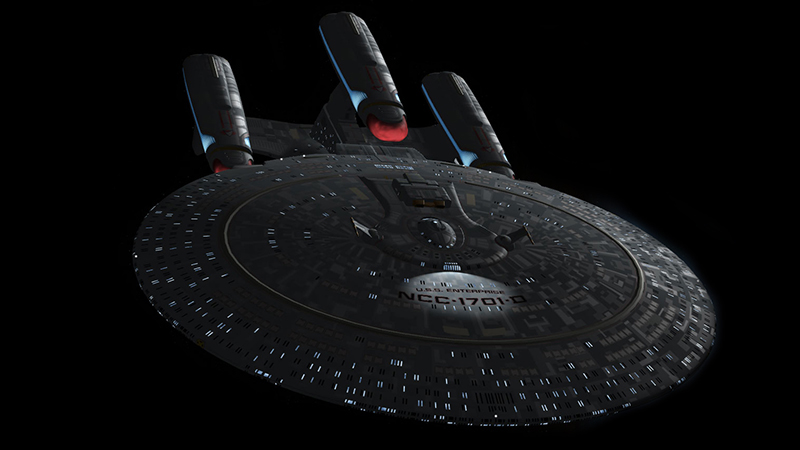
Notes: The Galaxy Refit class is a future Starfleet battleship from around the year 2400. The aging Galaxy class ships were due to be retired as a ship of the line, but the Enterprise-D with its long service history was refitted with modern weaponry, defenses, and engines, at the behest of Admiral Riker. The Galaxy refit classes most prominent feature is the third nacelle on the secondary hull, this along with the improved engine designs allow the ship to reach speeds in excess of warp 13, or warp 9.993 on the mid 24th century scale. The Galaxy Refit class also features a heavy beam cannon on the underside of the saucer section, this cannon is capable of piercing enemy shields and hulls with one blast. Along with the main cannon, sixteen new phaser arrays have been installed on the ship. The class may also have other upgraded system though no information exists on them.
tech button

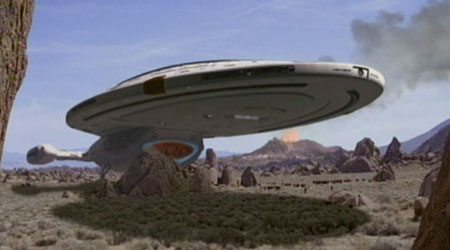
There are times when a starship maybe required to land on the surface of a planet, and return to oribit. Such situations include emergency landings, inoperable transporter systems, and extended repairs when space dock is not available. Currently only smaller Federation starships, such as the Intrepid and Defiant classes, are equipped with landing systems.

After entering the planet Â’s atmosphere the ship will extend landing struts from the bottom of the secondary hull that are capable of supporting the entire weight of the starship. When a landing site is selected the starship comes to zero forward velocity and descends vertically. The final decent is slowed by the ships n avigation thruster, such that it comes to a soft landing on the surface.

Landing a starship is not a recommended procedure as stresses can be extreme and unpredictable on a starship when entering the atmosphere. Use of transporters or shuttlecraft are the preferred method to reach a planetÂ’s surf.

Source : http://www.st-intelligence.com/