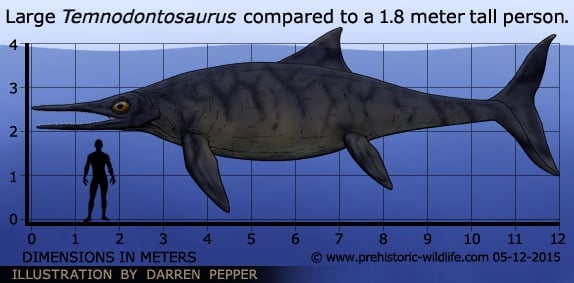
Temnodontosaurus

Megalodon

Mobil James Bond bakal Disulap Jadi Mobil Selam Sungguhan

XL Bidik 40 Persen Pelanggan Gunakan E-Channel

Idm 6.17 Full Version Download With Patch 100% working.

Showing posts with label Myth. Show all posts

Wednesday, January 1, 2014

Monsters in Greek Mythology

Some of the scariest creatures ever devised in the mind of man were introduced through Greek mythology. They were one-eyed and many-eyed giants, a three-headed dog, a terrifying woman with real-snake locks of hair, man-eating beasts with half-human bodies, giant-winged creatures with heads of beautiful maidens and many-headed grotesque sea monsters. They horrified and intrigued us, mesmerizing the deepest cubby-holes of our vivid imaginations.

CYCLOPES
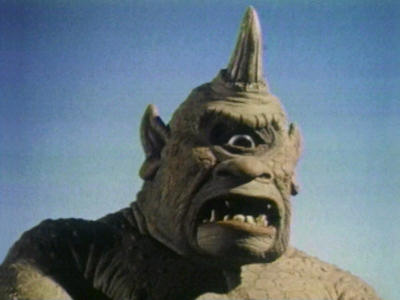
Cyclops
Gigantic one-eyed monsters that represented thunder, lightning and the lightning bolt. They were giants with a single eye in the middle of their forehead and four dispositions. The Cyclopes gave Zeus his weapons of thunder and lightning, which aided greatly in the defeat of the ten-year war against the Titans. The wandering hero, Odysseus, blinded the Cyclops Polyphemus, who happened to be a son of Poseidon. They were the first smiths, and created Poseidon’s trident, Artemis’ bow and arrows of moonlight, Apollo’s bow and arrows of sun rays, and Hades’ helmet of darkness. Noises proceeding from the heart of volcanoes were attributed to their forge operations.

MEDUSA
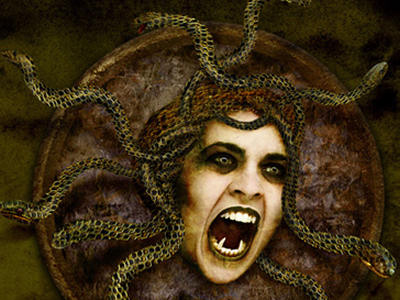
Medusa
A former mortal maiden of great beauty who was transformed into an ugly monster with snake-like hair by Athena after Poseidon raped her on her temple floor. She was so hideous that anyone who looked upon her was turned to stone. Perseus eventually beheaded Medusa, and her head was placed on the shield of Athena. It is said that Medusa’s blood that dripped from her wounds after her decapitation caused the innumerable serpents that infest Africa today.

MINOTAUR

The minotaur was a fearful man-eating beast who was half-man and half-bull. To prevent the minotaur from eating his own people, Minos had the beast shut up in a complex maze. Each year, Minos ordered the Athenians to send over seven young men and seven young women to be fed to the minotaur. Theseus volunteered to replace one of the young men who was to be sacrificed to the monster, and successfully solved the maze and slayed the minotaur.

SIRENS
Sirens
The Sirens were sisters-giant, winged creatures with the heads of beautiful women-who lured sailors to the deaths. Their songs were irresistible and lured boats towards treacherous rocks that would cause their demise. Odysseus filled his sailors’ ears with wax so that they could sail safely past the enchanting music of the Sirens.

ARGUS

450 × 410 - theoi.com
A giant with one hundred eyes (the “all-seeing one”), Argus’ most infamous role was that as guardian over IO, the heifer-nympth loved by Zeus. Zeus’ jealous and vengeful wife, Hera, employed him to watch over her night and day with his many eyes. Finally, he was killed by Hermes, and Hera put Argus’ eyes in the tail of the peacock, her favorite bird.

CERBERUS


The huge and powerful three-headed dog with a snake tail owned by Hades, Lord of the underworld. Snakes heads also protruded from his back. He used this fearsome hound to guard the entrance to his dark realm, allowing the dead to enter, but never to leave. Fetching Cerberus from the underworld and presenting him to King Eurystheus was the last labor of Heracles.

SCYLLA
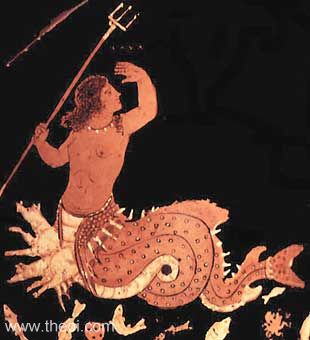
Scylla, the sea-monster | Paestan red figure krater C4th B.C. | J. Paul Getty Museum, Malibu
Scylla was a horribly grotesque sea monster, with six long necks equipped with grisly dog-heads, each of which contained three rows of sharp teeth. Her body consisted of twelve canine legs and a cat’s tail. She ate sailors alive, including some of Odysseus’ men.

CHARYBDIS
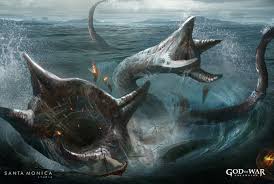


Charybdis took form as a monstrous mouth who swallowed huge amounts of water three times a day and then belched back out creating whirlpools, which caused destruction to many ships and the deaths of many sailors. She was originally a sea-nymph who was turned into a sea monster by Zeus as punishment for stealing Heracles’ cattle.

Source :http://www.lifepaths360.com

Tuesday, November 12, 2013

Poseidon vs Zeus


In Greek mythology, Poseidon and Zeus were brothers (the children of Cronus and Rhea) and two of the Twelve Olympians, the principal gods of the Greek pantheon, residing atop Mount Olympus.
According to a single reference in the Iliad, when the world was divided in three by a draw of lots, Zeus received the sky and air, and Poseidon received the sea. Their sibling Hades received the underworld.

Comparison chart</> Embed this chart

 
Improve this chart Poseidon
  • Currently 4.45/5
  • 1
  • 2
  • 3
  • 4
  • 5
Rating: 4.5/5 (397 votes)
Poseidon
Zeus
  • Currently 3.75/5
  • 1
  • 2
  • 3
  • 4
  • 5
Rating: 3.7/5 (322 votes)
Zeus
Abode: Seas and oceans Mount Olympus
Children: Theseus, Triton, Polyphemus, Pegasus, Chrysaor, Otos, Ephialtes, Hippothoon, Neleus, Pelias, Merman, Nausithous, Nauplios, Arion, Euadne, Orion, and etc. Ares, Athena, Apollo, Artemis, Aphrodite, Dionysus, Hebe, Hermes, Heracles, Helen of Troy, Hephaestus, Perseus, Minos, the Muses, the Graces
Siblings: Hades, Demeter, Hestia, Hera, Zeus Hestia, Hades, Hera, Demeter, Poseidon
Consort: Amphitrite Hera and various others
Parents: Cronus and Rhea Cronus and Rhea
Roman equivalent: Neptune Jupiter
Introduction (from Wikipedia): In Greek mythology, Poseidon [Pro.( /puh-sy'-duhn/)] is the god of the sea and, as "Earth-Shaker," of earthquakes. His symbols are the trident, swordfish, dolphin, horse, bull, and pearl shell. In the ancient Greek religion, Zeus is the "Father of Gods and men" (πατὴρ ἀνδρῶν τε θεῶν τε, patḕr andrōn te theōn te) who rules the Olympians of Mount Olympus as a father rules the family. He is the god of sky and thunder
The Big 3 (brothers): 2nd oldest Youngest
Symbols: Trident, swordfish, dolphin, horse, and bull. Thunderbolt, eagle, bull, and oak.
Origin: Poseidon was a son of Cronus and Rhea. In most accounts he is swallowed by Cronus at birth but later saved, with his other brothers and sisters, by Zeus. Like other children of Cronus and Rhea, Cronus wanted to swallow Zeus at birth. But when Rhea gave birth to Zeus in Crete, she handed Cronus a rock wrapped in swaddling clothes, which he promptly swallowed.

Source : http://www.diffen.com

Zeus


picture of Zeus, the King of the Gods in Greek mythology
Greek pronunciation
English pronunciation
Zeus photo gallery

Family of Zeus

Parents: Zeus was the last child of the Titans Cronus and Rhea.
Siblings: Zeus had five older siblings. Two brothers (Poseidon, Hades), and three sisters (Hestia, Hera, Demeter).
Wife: Zeus married his own sister Hera, the goddess of marriage and monogamy, but was giving her plenty of reasons to be jealous, since Zeus was renowned of his numerous love affairs. As a result, Zeus fathered plenty of children.

Role and Responsibilities

Zeus had his golden throne on the highest summit of Mount Olympus and was respected and awed by all Gods and mortals. All the kings boasted that they descended from Zeus.
Zeus was the "Lord of Justice", punishing anyone who lied or broke an oath, but was fair and always striving to keep a balance of all things.
Furthermore, Zeus was responsible for the weather and was shaping it according to his temper. When in high spirits, Zeus was blessing the world with fine weather; in case of bad mood, however, he would throw rain, winds, lightnings and thunderbolts to cause disaster to the mortals.

But even Zeus' powers had their limits, for, however powerful as he was, he had neither the right nor the ability to intervene in the decisions of the Fates.

The Personality of Zeus

Zeus was carefree and loved to laugh out loud[1]. He possessed the perfect knowledge and was just, merciful and prudent. However, he was rather unpredictable, since no one could guess the decisions he would make.

Appearance of Zeus

Zeus was strong and imposing, with long, oftentimes curly hair.

Symbols of Zeus

The symbols of Zeus were the scepter, the throne and the thunderbolt, which was as a gift from the Cyclopes because he liberated them. Zeus' tree was the oak tree and his sacred animal was the eagle.

The Roman name of Zeus is "Jupiter"
 Source : http://www.greek-gods.info

Friday, November 8, 2013

Athena, goddess of wisdom


Though Hercules had an enemy, Hera, on Mount Olympus, he also had a friend.

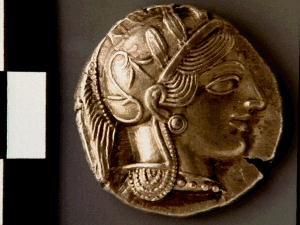
Dewing 1595, silver Athenian tetradrachm (=4 drachmas), ca. 449 - 420 B.C.
The goddess Athena, wearing a helmet.
Photograph by Maria Daniels, courtesy of the Dewing Greek Numismatic Foundation
Athena, the goddess of wisdom and military victory, and also the patron of the city of Athens, was Hercules' half-sister. Her parents were Zeus and Metis, a nymph. Zeus heard a prophecy that the child Metis bore after she gave birth to Athena would become the lord of heaven, so, to prevent this from happening, he swallowed Metis while she was still pregnant with Athena.
When the time came for Athena to be born, the smith god, Hephaistos, opened Zeus' head with an axe, and Athena stepped out, in full armor. The birth of Athena was a favorite topic of Greek vase painters.

Boston 00.330, Attic black figure panel amphora, c. 540 B.C.
The birth of Athena. The goddess leaps, wearing armor, from the head of her father, Zeus.
Courtesy, Museum of Fine Arts, Boston. H. L. Pierce Fund
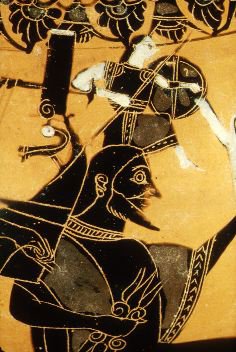
Athena often helped heroes, like Jason and Perseus. She wore an aegis, a goatskin shield which had a fringe of snakes. When Perseus killed the gorgon Medusa, whose face turned men to stone, he gave the gorgon head to Athena, and the goddess placed it on her aegis.

Toledo 1963.26, Attic black figure calyx krater, c. 520-515 B.C.
Athena wearing her aegis, with its snake-fringe and gorgon head
Photograph by Maria Daniels, courtesy of the Toledo Museum of Art
When Hercules went mad and killed his children, Athena stopped the disaster from getting worse. Just as the insane hero turned to kill Amphitryon, Athena threw a stone at Hercules, knocking him unconscious, so his mortal father was spared. Athena also helped Hercules at many points during his Labors. She provided him with the krotala he used to scare the Stymphalian Birds, and she carried the apples back to the garden of the Hesperides.

Source : http://www.perseus.tufts.edu

Monday, November 4, 2013

Neptune

I.Neptune

Poseidon picture 2Neptune was the son of Saturn, and Rhea or Ops, and brother of Jupiter. When arrived at maturity, he assisted his brother Jupiter in his expeditions, for which that god, on attaining to supreme power, assigned him the sea and the islands for his empire. Whatever attachment Neptune might have had to his brother at one period, he was at another expelled heaven for entering into a conspiracy against him, in conjunction with several other deities; whence he fled, with Apollo, to Laomedon, king of Troy, where Neptune having assisted in raising the walls of the city, and being dismissed unrewarded, in revenge, sent a sea-monster to lay waste the country.
On another occasion, this deity had a contest with Vulcan and Minerva, in regard to their skill. The goddess, as a proof of her's, made a horse, Vulcan a man, and Neptune a bull, whence that animal was used in the sacrifices to him, though it is probable that, as the victim was to be black, the design was to point out the raging quality and fury of the sea, over which he presided. The Greeks make Neptune to have been the creator of the horse, which he produced from out of the earth with a blow of his trident, when disputing with Minerva who should give the name to Cecropia, which was afterwards called Athens, from the name in Greek of Minerva, who made an olive tree spring up suddenly, and thus obtained the victory.
In this fable, however, it is evident that the horse could signify nothing but a ship; for the two things in which that region excelled being ships and olive-trees, it was thought politic by this means to bring the citizens over from too great a fondness for sea affairs, to the cultivation of their country, by showing that Pallas was preferable to Neptune, or, in other words, husbandry to sailing, which, without some further meaning, the production of a horse could never have done. It notwithstanding appears that Neptune had brought the management of the horse, as likewise the art of building ships, to very great perfection; insomuch that Pamphus, who was the most ancient writer of hymns to the gods, calls him the benefactor of mankind, in bestowing upon them horses and ships which had stems and decks that resembled towers.
If Neptune created the horse, he was likewise the inventor of chariot-races; hence Mithridātes, king of Pontus, threw chariots, drawn by four horses, into the sea, in honor of Neptune: and the Romans instituted horse-races in the circus during his festival, at which time all horses ceased from working, and the mules were adorned with wreaths of flowers.
Neptune, represented as a god of the sea, makes a considerable figure: he is described with black or dark hair, his garment of an azure or sea-green color, seated in a large shell drawn by whales, or sea-horses, with his trident in his hand, attended by the sea-gods Palæmon, Glaucus, and Phorcys; the sea-goddesses Thetis, Melita, and Panopēa, and a long train of Tritons and sea-nymphs.
The inferior artists represent him sometimes with an angry and disturbed air; and we may observe the same difference in this particular between the great and inferior poets as there is between the bad and the good artists. Thus Ovid describes Neptune with a sullen look, whereas Virgil expressly tells us that he has a mild face, even where he is representing him in a passion. Even at the time that he is provoked, and might be expected to have appeared disturbed, and in a passion, there is serenity and majesty in his face.
On some medals he treads on the beak of a ship, to show that he presided over the seas, or more particularly over the Mediterranean sea, which was the great, and almost the only scene for navigation among the old Greeks and Romans. He is standing, as he generally was represented; he most commonly, too, has his trident in his right hand: this was his peculiar sceptre, and seems to have been used by him chiefly to rouse up the waters; for we find sometimes that he lays it aside when he is to appease them, but he resumes it when there is occasion for violence. Virgil makes him shake Troy from its foundation with it; and in Ovid it is with the stroke of this that the waters of the earth are let loose for the general deluge. The poets have generally delighted in describing this god as passing over the calm surface of the waters, in his chariot drawn by sea-horses. The fine original description of this is in Homer, from whom Virgil and Statius have copied it.
In searching for the mythological sense of the fable, we must again have recourse to Egypt, that kingdom which, above all others, has furnished the most ample harvest for the reaper of mysteries. The Egyptians, to denote navigation, and the return of the Phœnician fleet, which annually visited their coast, used the figure of an Osīris borne on a winged horse, and holding a three-forked spear, or harpoon. To this image they gave the name of Poseidon, or Neptune, which, as the Greeks and Romans afterwards adopted, sufficiently proves this deity had his birth here. Thus the maritime Osīris of the Egyptians became a new deity with those who knew not the meaning of the symbol.

Source: Roman Antiquities, and Ancient Mythology by Charles K. Dillaway